


Humanists UK Convention 2025
Friday 13 June, 19:00 –
Sunday 15 June, 15:15
Octagon Centre
Clarkson Street,
Sheffield
S10 2TQ
Taking place alongside Convention 2025
Humanism in Action
Friday 13 June,
11:00–17:00
Humanists UK AGM
(Members only)
Sunday 15 June,
15:45–17:15
TICKET SALES CLOSED

Helen
Czerski

Ian
Dunt

Sara
Wahedi

Harvey
Whitehouse

Azeem
Ibrahim

Deborah
Hyde

George
Askwith

Ffion
Autumn

Neil
McKain

Alfredo
Carpineti

Hannah
Platt

Olga
Koch

Ann
O’Connell

Gary
McLelland

Clare
Elcombe Webber

Karen
Wright

Richard
Layard
(Lord Layard)

Claudia
Aradau

Kate
Devlin

Will
Storr

Charlotte
Lydia Riley

Katherine
Stewart

Andrew
Copson

Madeleine
Goodall

Richard
Norman

Luke
Donnellan

Lizzi
Collinge MP

Niki
Seth-Smith

Andrew
Russell

Kathy
Riddick

Paul
Fitzgerald

Terri
O’Sullivan

Sean
McLoughlin

Andrew
West

Claudia Aradau
Professor Claudia Aradau is Professor of International Politics in the Department of War Studies at King’s College London. Her current research focuses on how digital technologies reconfigure security and surveillance practices, and how algorithms and machine learning recast relations between security, democracy, and critique.
Her latest book, Algorithmic Reason: The New Government of Self and Other (with Tobias Blanke) won the 2023 Best Book Award by the Science, Technology and Arts in International Relations section of the International Studies Association.
Claudia spent a decade as associate editor and editor of Security Dialogue and 15 years as a member of the editorial collective of Radical Philosophy. She is currently co-editor of International Theory. She is Principal Investigator of SECURITY FLOWS (‘Enacting border security in the digital age: Political worlds of data forms, flows and frictions’), funded by the European Research Council, which seeks to analyse how datafication – the process of transforming our everyday lives into quantifiable digital data – is also transforming borders today.
Alfredo Carpinenti
Dr Alfredo Carpineti (he/him) is an astrophysicist and communicator, working for IFLScience for nine years. He is the staff writer and space correspondent. He is committed to fighting inequity in STEM and is the chair and founder of Pride in STEM, the largest UK charity dedicated to supporting LGBT People in STEM.
He’s an avid science communicator producing videos and podcasts under the moniker The Astroholic. He’s writing a book, Invisible Rainbows, about all the astronomical discoveries conducted with light beyond the range that humans can see.
Lizzi Collinge MP
Lizzi Collinge is the Labour MP for Morecambe and Lunesdale, and Chair of the All-Party Parliamentary Group.
We have reached out to invite MPs from all parties with humanist membership sections.

Andrew Copson
Andrew Copson is Chief Executive of Humanists UK, responsible for day-to-day management of the organisation as a whole, and management of the staff team. He has been Chief Executive of Humanists UK since 2010, prior to which he worked across educational and public affairs roles within the charity.
He is an expert on humanism who has written widely on the subject, and is regularly invited to appear on TV and radio news programmes. As well as these roles, Andrew is a trustee of the Religious Education Council and President of Humanists International – the umbrella body bringing the global humanist movement together to pursue human rights at an international level.
Helen Czerski
Dr Helen Czerski is a physicist, oceanographer, broadcaster, and author. Whilst Helen’s primary academic interests are those of the physics of the oceans, she describes herself as a lover of the science of the ‘everyday world’.
Helen’s passion for a broad range of scientific endeavours, as well as her skill in science communication, has made her well known as the presenter of a host of popular BBC TV and radio science programmes and documentaries. She also gave a talk on the impact of oceans on human civilisations to a packed house at the 2017 Humanists UK Convention. Helen is a patron of Humanists UK.
Her latest book is Blue Machine: How the Ocean Shapes Our World.
Kate Devlin
Professor Kate Devlin is a leading expert on Artificial Intelligence (AI) and Society, serving as Professor in the Department of Digital Humanities at King’s College London. Her research explores how people interact with technology, both historically and in the future. With a background in archaeology and a PhD in computer science, she bridges the arts and sciences to examine AI’s societal impact.
Her 2018 book, Turned On: Science, Sex and Robots, critically examines the ethical and social implications of intimacy with technology, praised for its accessible and thought-provoking insights.
Kate leads King’s College London’s role in the £31 million Responsible AI UK programme, funded by UK Research and Innovation, bringing together researchers to shape AI development for societal benefit.
Beyond academia, she serves on the board of the Open Rights Group, advocating for digital rights. In 2022, she became a patron of Humanists UK and represents Humanists UK as a Commissioner for the AI, Faith & Civil Society Commission.

Luke Donnellan
Luke Donnellan is Director of Understanding Humanism, where he is responsible for promoting the understanding of humanism, especially in formal education settings. He manages Humanists UK’s school speakers programme; teacher training and CPD; and the production of educational resources. He is the co-author of Understanding Humanism, writer and editor of the online courses Introducing humanism and Humanist lives, and writer-director of Humanists UK’s recent short film with Alice Roberts, One Life, Live It Well.
Ian Dunt
Ian Dunt is a political journalist, author, and broadcaster, known for his insightful analysis of the UK’s political landscape. He currently serves as a columnist for the i newspaper and co-hosts the ‘Origin Story’ podcast with Dorian Lynskey. Previously, he was the editor of politics.co.uk and a host on the ‘Remainiacs’ podcast.
In his 2023 book, How Westminster Works… and Why It Doesn’t, he offers a critical examination of the UK’s political system. He delves into the complexities of parliamentary procedures, the influence of special advisers, and the functionality of institutions like the House of Lords. The book aims to demystify the often opaque workings of Westminster, highlighting systemic issues and proposing avenues for reform.
Ian’s previous works include Brexit: What the Hell Happens Now?, an influential guide to the Brexit process, and How To Be A Liberal, which traces the history and importance of liberalism in modern society.
Beyond his writing, Ian frequently appears on television and radio, providing commentary on political developments. His work is driven by a commitment to clarity and transparency in political discourse, aiming to make complex political processes accessible to the public.
Clare Elcombe Webber
Clare Elcombe Webber is Director of Humanist Care at Humanists UK, overseeing two key support programmes. She leads strategic work to make chaplaincy services inclusive for non-religious people, and the delivery of this through the Non-Religious Pastoral Support Network. She also oversees Faith to Faithless, which supports individuals leaving high-control religions, and advocates to improve policies affecting them. Clare chairs the Network for Pastoral, Spiritual, and Religious Care in Health and is the humanist/non-religious advisor to HMPPS and the MoD.
Previously, Clare had a career in the violence against women and girls (VAWG) sector in leadership, strategic, and commissioning roles. She spent time as a security consultant for the Home Office and Parliament, as a script consultant for Eastenders, developing new psychological advocacy services, and as part of a multi-agency service for stalking victims and perpetrators. Clare holds a BSc in psychology and an MSc in applied positive psychology, with a research focus on vicarious trauma in professionals.
Paul Fitzgerald
Paul ‘Polyp’ Fitzgerald is a cartoonist, graphic novelist, and prop builder based in Manchester. A humanist freethinker, he also serves as chair of the Peterloo Memorial Campaign. Fitzgerald is renowned for his intricate and thought-provoking work, tackling complex political, social, and environmental issues through his cartoons and graphic novels.
He has published a significant graphic biography exploring the life and enduring ideas of the radical thinker Thomas Paine. This work utilises Fitzgerald’s detailed illustrative style to vividly bring Paine’s eighteenth-century era and revolutionary arguments to life for a modern audience. Paul’s distinctive approach across his broader work often focuses on themes like climate change, economic inequality, corporate power, and social justice, presenting sharp commentary aimed at making challenging subjects accessible and engaging.
Ffion Autumn
Ffion Autumn was born in a Middle Eastern country where religion, government, and culture are deeply intertwined. ‘Muslim’ was printed on her birth certificate and passport. From a young age, she questioned Islam but was met with punishment rather than answers. Forced into marriage and later fighting for divorce, she came to fully understand the limits on her freedom and safety as a lesbian and atheist in an Islamic society. She seized the opportunity to study in the UK and chose to stay for her safety, at great personal cost, losing both her family and a successful career. While pursuing a PhD, she met George and joined Faith to Faithless as a volunteer.
Together, Ffion and George launched the first Faith to Faithless social group outside London, building a vibrant and supportive community of apostates in South Yorkshire. Over the past six years, this group has helped people navigate the complex journey of leaving high-control religious communities. As their careers took them across the country, they established similar groups in Dorset, Hampshire, Cambridgeshire, and Leicestershire. George has also contributed to the Faith to Faithless research team, and given talks on apostasy and Faith to Faithless.
George Askwith
George Askwith grew up as a Jehovah’s Witness, indoctrinated from childhood and committed to the faith. But as she struggled to reconcile her sexuality with the expectations of the religion, the pressure to be the “perfect JW” became unsustainable. Exhausted and increasingly aware of her identity as a lesbian, she deconstructed her faith and stepped away from the religion. Meeting Ffion marked a turning point; to avoid excommunication and losing her family, George relocated across the country. Starting over while processing life outside the faith was incredibly challenging. Shortly after the move, she attended apostasy training by Faith to Faithless at Sheffield Hallam University and immediately began volunteering, bringing Ffion along with her.
Together, George and Ffion launched the first Faith to Faithless social group outside London, building a vibrant and supportive community of apostates in South Yorkshire. Over the past six years, this group has helped people navigate the complex journey of leaving high-control religious communities. As their careers took them across the country, they established similar groups in Dorset, Hampshire, Cambridgeshire, and Leicestershire. George has also contributed to the Faith to Faithless research team, and given talks on apostasy and Faith to Faithless.
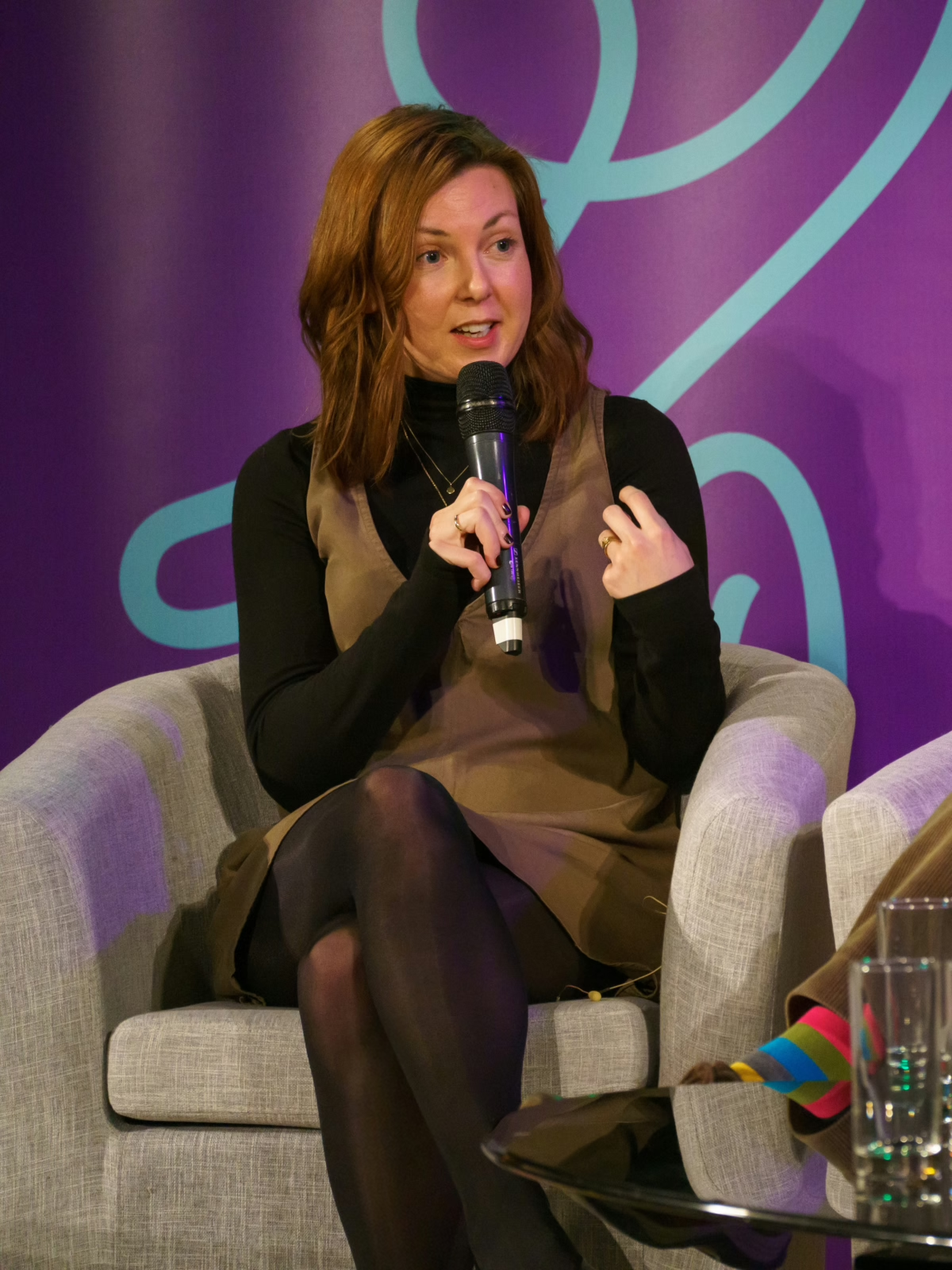
Madeleine Goodall
Madeleine Goodall is Humanist Heritage Manager at Humanists UK. Since 2019, she has been researching and sharing the rich history and influence of non-religious people in the UK, alongside a team of volunteers and experts, on the Humanist Heritage website and through a range of events and resources. A particular passion has been uncovering the stories of women in the humanist movement, and she has written about these for publications including New Humanist, History Workshop Online, and The Humanist (US).
Madeleine gives regular talks on humanist history, and has also developed a series of heritage walks across the UK, often working closely with local humanist groups. This year, she concluded the two year National Lottery Heritage Fund supported project Humanist Heritage: Doers, Dreamers, Place Makers, which saw the creation of interactive virtual tours of London’s Conway Hall, the digitisation of archive material, and an oral history project, public exhibition, and range of events marking the 45th anniversary of LGBT Humanists.

Deborah Hyde
Deborah Hyde is a folklorist and cultural anthropologist. For ten years, she was the editor of the Skeptic magazine, the UK’s only regular magazine to take a critical-thinking and evidence-based approach to pseudo-science and the paranormal. Deborah wants to know why people believe in weird stuff. She attributes her fascination with the supernatural to having spent her childhood with mad aunties. She approaches the subject using the perspectives of psychology and history.
During the day, she’s a film and TV industry coordinator and production manager who has worked in makeup effects and scenery. She also gets on the wrong side of the camera from time to time.
Azeem Ibrahim
Dr Azeem Ibrahim OBE is a renowned scholar and author, serving as a Research Professor at the Strategic Studies Institute, US Army War College, and as Senior Director at the Newlines Institute for Strategy and Policy in Washington, DC. He earned his PhD from the University of Cambridge and has completed fellowships at Oxford, Harvard, and Yale universities.
In his 2022 book, Authoritarian Century: Omens of a Post-Liberal Future, Azeem examines the global shift towards authoritarianism and the challenges facing liberal democracies. He argues that economic and policy failures have eroded public trust in liberal institutions, leading to the rise of populist and authoritarian movements. In the book, he explores historical and contemporary factors contributing to this trend and offers insights into how liberal democracies can renew themselves to address these challenges.
Azeem has advised numerous world leaders on policy development and strategy. He has been recognized as a Top 100 Global Thinker by the European Social Think Tank, and named a Young Global Leader by the World Economic Forum. In 2022, he was awarded an OBE for his services to foreign policy.
Olga Koch
Olga Koch is a writer and comedian, across radio, television and film. She was nominated for Best Newcomer at the Edinburgh Fringe Festival in 2018, Best Show at Leicester Comedy Festival in 2020, longlisted for Best Stand Up Show at the National Comedy Awards in 2021 and her show ‘Fight’ won the 2022 Writers Guild Award for Best Radio Comedy.
She has also appeared on Mock the Week (BBC Two), QI (BBC Two), Frankie Boyle’s New World Order (BBC Two), Late Night Mash (Dave), Richard Osman’s House of Games (BBC Two), Guessable (Comedy Central), Question Team (Dave) and Live at the Apollo (BBC Two).
She is currently developing a book about online behaviour and parasocial relationships.
Richard Layard, Lord Layard
Professor Lord Layard is a distinguished economist dedicated to enhancing societal well-being by addressing unemployment and inequality. He pioneered the integration of happiness studies into economic research, emphasising the importance of aligning cost-benefit analyses with genuine human values. As the founder and former director of the London School of Economics’ Centre for Economic Performance, he currently leads its Wellbeing Programme.
In 2005, Lord Layard authored Happiness: Lessons from a New Science, a seminal work translated into 20 languages, which examines the profound impact of factors beyond income on overall happiness. He expanded on this theme with the 2018 co-authored publication, The Origins of Happiness: The Science of Wellbeing Over the Life Course. His most recent book, Wellbeing: Science and Policy, published in 2023, stands as the first comprehensive textbook on wellbeing science.
Beyond his academic contributions, Lord Layard has actively engaged in discussions on humanism. In a 2013 House of Lords debate, he highlighted the significant role of humanists in British society, acknowledging their efforts in promoting free speech, secularism, and human rights. The debate also celebrated the work of Humanists UK in public policy and ethical issues.
Charlotte Lydia Riley
Dr Charlotte Lydia Riley is a historian of 20th-century Britain at the University of Southampton, specialising in questions about empire, politics, culture and identity. She is editor of The Free Speech Wars and author of Imperial Island: A History of Empire in Modern Britain. Her writing has appeared in a wide range of publications including the Guardian, New Statesman, Financial Times, Washington Post and History Today.
Neil McKain
Neil McKain is a Head of Religious Studies with over ten years teaching experience. He graduated in Theology and RS from the University of Leeds and holds an MA in Philosophy and Religion from the University of London. His work nationally in RE has been extensive. Neil is part of an advisory group to the Rt Hon Charles Clarke and Professor Linda Woodhead in their work on a new legal settlement for RE.
Neil has served on the executive of the National Association for Teachers of RE (NATRE) for the last six years and is a member of the RE working group at OFSTED. He is a published author of student textbooks as well as articles on RE more generally.
Neil also serves as a primary school governor with responsibility for curriculum and standards. Neil is a committed humanist and a firm advocate for RE which is objective, fair, and balanced.
Gary McLelland
Gary McLelland has been Chief Executive of Humanists International, since February 2017. Before this, he worked for the Humanist Society Scotland since 2013 as Head of Communications and Public Affairs. He has also previously served as a Board member of the European Humanist Federation based in Brussels, as well as a board member of the Scottish Joint Committee on Religious and Moral Education.
Before working in humanist campaigning, Gary worked for a global citizenship project at the Mercy Corps European headquarters in Edinburgh, and also in policy and service delivery in education and social work.
He has a BSc (hons) in psychology, a diploma in childhood and youth studies and master’s in human rights law, in which he researched the approach of the European Court of Human Rights and the United Nations’ approach to so-called ‘blasphemy laws’.
Sean McLoughlin
Sean McLoughlin is an acclaimed stand-up comedian and writer based in London. Hugely in-demand in the UK and internationally, he has made appearances on Live At The Apollo, Mock The Week, The Stand-Up Sketch Show, Stand-Up Central and Kevin Hart’s LOLNetwork among others.
Sean has played solo shows on four continents, and has opened for Bill Burr at the Royal Albert Hall, Ricky Gervais at the Hollywood Bowl and performed a gala show at the Sydney Opera House. He’s also released two specials and three hugely successful U.S. comedy albums. He has made multiple TV and radio appearances and his material on the world of technology has even seen Sean invited to perform at multiple high-profile tech conferences, including the keynote speech at E-Day in Amsterdam.
Richard Norman
Richard Norman is Emeritus Professor of Moral Philosophy at the University of Kent, and author of many books including On Humanism, co-author (with Andrew Copson and Luke Donnellan) of Understanding Humanism, and co-editor of Religion and Atheism: Beyond the Divide.
His forthcoming book, What is Humanism For?, will be published in June 2025, and Religion and Atheism in Dialogue, co-edited with Anthony Carroll, will be out in July.
Richard is on the committee of Humanist Climate Action, and is a patron of Humanists UK.
Ann O’Connell
Ann O’Connell is a member of the board of Humanists UK. A committed humanist, she shares the Humanists UK vision of personal fulfilment found in our connections with others, and finding meaning in science, reason, compassion, and creativity. Ann is a trustee and treasurer of the Leicestershire and Rutland branch of Emmaus UK, a national charity which works to end homelessness. She is also a Director of Leicester Health Insight (LHI) a not for profit company which aims to facilitate improvements in health and social care for the population of Leicester city.

Terri O’Sullivan
Terri O’Sullivan is the Apostate Services Development Officer for Faith to Faithless, a service of Humanists UK. She runs the peer support programme, coordinates social events for the ex-religious all over the UK, she trains service professionals on the issues apostates face through Apostasy Awareness courses. In 2007, she founded XJW Friends, a support and social group for former Jehovah’s Witnesses now with nearly 2,000 members. She holds a BSc. and MSc. in social psychology from the University of Kent and Tilburg University in the Netherlands, where she conducted research on the psychological effects of long-term ostracism from a religious community.

Hannah Platt
Hannah Platt is the ‘voice of a generation’ (The Skinny) with ‘humour sharp enough to draw blood’ (Guardian); she is ‘an undeniable rising star’ (Fest Magazine) of the UK comedy scene. Her debut Fringe show was nominated for four awards including NextUp’s Biggest Award in Comedy, and earned her five- and four-star reviews from the likes of the Scotsman, DIVA magazine, and Chortle. She has appeared on Comedy Central Live, BBC Three and Radio 4, and supported Fern Brady, Ashley Gavin, and Lou Sanders amongst others on their UK tours.

Kathy Riddick
Kathy Riddick leads Humanists UK’s work in Wales as Coordinator of Wales Humanists, the section bringing together all of Humanists UK’s members and supporters in Wales. She is also Campaigns Manager in the Public Affairs and Policy team working across all Humanists UK campaigns. She came to Humanists UK after a successful career in business consulting and communications. As well as representing Wales Humanists to senior stakeholders in the Welsh Government, Kathy ensures that the voice of humanists in Wales is fully represented in public policy discussions, Senedd debates, and in the media, and works to expand the availability of humanist ceremonies, pastoral support, and resources for teachers in Wales.
Andrew Russell
Andrew Russell is a public affairs and communications consultant, and investor specialising in the education and healthcare sectors. At present he is working with clients trying to tackle the care crisis across Europe. Passionate about rational, respectful dialogue and debate, between 2015 and 2022 he served as a trustee of The Philosophy Foundation, a charity that promotes the teaching and practice of Philosophy across the UK. In his spare time he runs two book clubs with over 5,000 members and is forever trying to finish a book of his own. He is a board member of Humanists UK.
Niki Seth-Smith
Niki Seth–Smith is the editor of New Humanist magazine, the historic quarterly publication exploring culture, ideas, science, and philosophy from a rationalist and humanist perspective. The magazine, originally founded in 1885 and published for many years by the Rationalist Association, is now published by Humanists UK following a merger in early 2025.
Niki, who assumed the editorship after Spring 2023, is also a journalist and fiction writer. Her non–fiction work, often focusing on politics, culture, and gender, has appeared in outlets such as Vice, Al Jazeera, and openDemocracy. As a fiction writer, she is interested in storytelling’s potential and is currently working on both speculative novel and auto–fiction projects.

Katherine Stewart
Katherine Stewart is the New York Times-bestselling author of Money, Lies, and God: Inside the Movement to Destroy American Democracy (Bloomsbury, 2025).
Her previous book, The Power Worshippers: Inside the Dangerous Rise of Religious Nationalism, was awarded first place for Excellence in Nonfiction Books by the Religion News Association as well as a Morris D. Forkosch award for Best Book in Humanism and formed the basis of the documentary feature God & Country, produced by Rob Reiner and Michele Reiner.
She is the recipient of the Freedom From Religion’s 2024 Freethought Heroine of the Year award.

Will Storr
Will Storr is an acclaimed writer and thinker, known for his work on storytelling, psychology, and the human condition. His books, including Selfie, The Science of Storytelling, and The Status Game, have been widely praised by critics and influential figures across journalism, academia, and the arts. His work is read by leading public intellectuals, cultural commentators, and comedians alike, with admirers ranging from Philippa Perry and Susan Cain to Jimmy Carr and Fern Brady. He is the author of the bestselling Substack newsletter You Are A Story.
Will’s 2021 book, The Status Game, explores how status drives human behaviour, shaping our relationships, identities, and even morality. Blending psychology, history, and social science, it examines why status matters and how it influences the way we see ourselves and others.
Previously, Will was an award-winning longform journalist, specialising in human rights reporting across Latin America, Africa, and remote Aboriginal communities in Australia. His work has appeared in The Guardian, The Sunday Times, The Observer, The New York Times, and The New Yorker. His groundbreaking reporting on sexual violence against men earned the Amnesty International Award and the One World Press Award, and his BBC documentary work was recognised with the Association for International Broadcasting Award for Best Investigative Documentary.
Sara Wahedi
Sara Wahedi is the CEO of Civaam and the founder of Ehtesab, Afghanistan’s first civic-technology startup. Her work focuses on developing responsible AI and digital infrastructure for fragile and conflict-affected settings.
Through Ehtesab, she pioneered real-time civic alert systems in Afghanistan, helping keep civilians informed and safe in the absence of functioning institutions. Since its launch, it has sent over 250,000 alerts.
Wahedi advises international organizations, UN agencies, and governments on civic technology, crisis governance, and the protection of ‘Access to Information’ as a fundamental human right, as outlined in Article 19 of the Universal Declaration of Human Rights.
She is a Global Ambassador for Women for Women International and serves on the Board of Directors for Fast Forward 2030 at University College London. She has been recognised for her work by TIME magazine as a Next Generation Leader, and by MIT Technology Review as a Leading Innovator Under 35; she is one of Forbes’ 30 Under 30, and one of the BBC’s 100 Most Influential Women. She is currently completing a Master of Public Policy at the University of Oxford.
Andrew West
Andrew West is Director of IT at Humanists UK. He joined in May 2011, after two years volunteering as Humanists UK’s Photographer-in-Residence. He is responsible for managing and coding the Humanists UK website, its many spin-off websites, the office computers, and the contact database. Outside of the office he is a private pilot and ballroom dancer. He also represented Humanists UK on the Fourth Plinth, back in the day.
Harvey Whitehouse
Professor Harvey Whitehouse is a distinguished anthropologist renowned for his research into the evolution of human culture and social structures. He holds the position of Chair in Social Anthropology at the University of Oxford and serves as Director of the Centre for the Study of Social Cohesion.
Over four decades, Professor Whitehouse has conducted extensive fieldwork in diverse and challenging environments, including millenarian cults in Papua New Guinea, battlefields during the Arab Spring, and among violent football gangs in South America. His pioneering ‘modes of religiosity’ theory examines how the frequency and emotional intensity of rituals influence the formation and cohesion of religious communities.
Professor Whitehouse’s work has been featured in prominent publications such as the Guardian, Telegraph, Scientific American, and New Scientist. He has also delivered hundreds of talks across six continents, including at the World Economic Forum.

Karen Wright
Karen Wright is Humanists UK’s Public Affairs Manager and has held this role since 2018. She is responsible for managing the organisation’s external stakeholders such as parliamentarians, civil servants, and other civil society relationships, as well as the organisation’s attendance at party conferences. She acts as Secretariat to the All-Party Parliamentary Humanist Group, which brings together around 130 MPs and peers to raise the humanist voice in Parliament, and holds regular events on matters of interest to humanists. She works across the Public Affairs and Policy team to advocate policy to decision-makers and leads on a number of campaigns, including calling for legal recognising humanist marriages in England and Wales, decriminalising abortion, and making the UK Parliament inclusive of all regardless of religion or belief.
Outside of Humanists UK, Karen works part time for Lord Dubs, patron of Humanists UK, who sits in the House of Lords.

Getting to Sheffield
Sheffield is well-connected from across the UK. You can reach Sheffield city centre by train direct from Birmingham or Manchester in 60 minutes or less, direct from London in under two hours, and direct from Bristol in under three hours – all far faster than driving, even in the best conditions (according to Google Maps).
Getting to our venue
Sheffield railway station is directly integrated with the city’s Supertram network, which passes through the city centre – host to a range of hotels – and serves our venue (with the University of Sheffield tram stop).
There is a taxi rank outside Sheffield station, which also serves private hire cars.
There is a Q-Park car park located just across the road from our venue.
What is humanism for? | Professor Richard Norman, Kathy Riddick
Saturday 09:05–09:55 | Octagon
Most of us think we know what humanism is – but why do we need it? If people are leaving organised religions, why do they need another package deal, a new -ism? Why not just leave them to arrive at their own individual sets of beliefs and values? This is the question which Richard will share with us, and it is the subject of his new book, What Is Humanism For?. In attempting to formulate some answers, he will look at what humanism has to offer in the face of the mounting crises – ethical, political, AND environmental – which confront us all.
Human-centred technology in a world of crisis | Sara Wahedi, Gary McLelland
Saturday 10:05–10:55 | Octagon
As artificial intelligence and digital systems increasingly shape how societies govern, communicate, and deliver aid, the question of who these systems serve – and who they exclude – has never been more urgent. Drawing on her experience leading civic technology in Afghanistan and adapting it in the wake of the Taliban’s return, Sara Wahedi reflects on what it means to design technology in contexts where freedom, safety, and access to information are constantly under threat.
This session will explore how digital infrastructure can protect rather than endanger, and how innovation must respond to the needs of those living under censorship, surveillance, and systemic collapse. It considers how human-centred design must evolve when the users are not just consumers, but survivors. From her work in conflict-affected regions to global advisory roles on technology and human rights, Wahedi offers a powerful argument for placing dignity and accountability at the core of technological development.
Invisible rainbows | Dr Alfredo Carpineti, Ann O’Connell
Saturday 10:05–10:55 | Uni Central
The light we can see is only a small part of the whole electromagnetic spectrum. From radio waves to gamma rays, there is so much of the universe that is invisible to us and we will explore these phenomenal objects and events in this talk.
The status game | Will Storr, Karen Wright
Saturday 11:20–12:10 | Octagon
In his books, Will Storr argues that humans live their lives as status games, but experience them as heroic stories. Telling the story of Marada Dynda, who became sucked into the anti-vaxx movement, in this talk, Storr will show how his theory leads to widespread irrationality.
The new algorithmic age: ethics, society, and our AI future | Professor Claudia Aradau, Professor Kate Devlin, Sara Wahedi
Saturday 11:20–12:10 | Uni Central
How can AI development promote, and not undermine, democratic principles? What safeguards are needed for individual autonomy in an algorithm-driven world? How can technology’s empowering potential benefit humanity, especially vulnerable groups, while mitigating risks? And what is democracy’s future when inscrutable algorithms influence societal decision-making?
Join Claudia Aradau, Kate Devlin, and Sara Wahedi to explore all these questions and more, in a crucial conversation on the complexities of our rapidly developing digital world, and what we must do now to bring about an understandable, accountable, and transparent AI serving humanity and upholding – not subverting – democratic and humanist values.
Humanists in Parliament | Lizzi Collinge MP, Andrew Copson
Saturday 13:25–14:15 | Octagon
Join Lizzi Collinge MP, Chair of the All-Party Parliamentary Humanist Group (APPHG), in conversation with Andrew Copson to hear about what it is like being a humanist parliamentarian in Westminster. Learn what the APPHG is doing to raise the humanist voice in Parliament, and how you can get involved to create positive, lasting change.
Plus, take part in a Humanists UK campaign activity to invite the Justice Secretary to legally recognise humanist marriages in England and Wales.
Is free speech under threat? | Dr Charlotte Lydia Riley, Andrew Copson
Saturday 14:25–15:15 | Octagon
Who gets to exercise free speech, and what happens when powerful voices think they have been silenced?
Free speech has been reinvigorated as a political issue in recent years – from controversies around protest, to concerns around hate speech, the question of who is allowed to speak and what they are allowed to say has been the topic of much debate.
There are doubtless real threats to people’s speech rights around the globe today. And yet, our contemporary ‘culture wars’ have positioned this issue in a very narrow space, one in which ‘cancel culture’ poses a far greater risk than authoritarianism, and in which it is the progressive left, not the reactionary right, who should be most feared when it comes to our ability to speak freely. Why is this, and what are the consequences of this framing?
Faith to Faithless: building community for the ex-religious | George Askwith, Ffion Autumn, Terri O’Sullivan, Clare Elcombe Webber
Saturday 14:25–15:15 | Uni Central
How do you start from scratch with finding a community which shares your values, understands your journey, and accepts you for who you are?
Leaving a high-control religious community that once provided all of your friends, family, and support can be very isolating. In addition to carrying trauma from the control and abuse experiences within the community, leavers may face shunning, public shaming, and in some cases threats and ongoing abuse or harassment.
Bearing this while starting to build a new life, deciding who they are, what they believe, and how they connect with others can be a struggle. Faith to Faithless offers people the opportunity to feel validated and find others who can relate, building a compassionate and understanding community. Just knowing you are not alone can be a life-saver. Join us to hear from Terri, George, and Ffion, who have all played their part in creating communities for ex-religious people.
Happiness as the goal for society | Professor Lord Richard Layard, Niki Seth-Smith
Saturday 15:45–16:35 | Octagon
Happiness should be the goal for society. It is the only good which is completely self-evidenced. In this talk, Professor Lord Layard will discuss how to promote this goal within government, at the workplace, and in education. He will focus on evidence such as that in the World Happiness Report, published annually, and in the positive psychology promoted by Action for Happiness and the World Wellbeing Movement. Finally, he will come to us as individuals – how we should try to create as much happiness in the world as we can, and how that objective would generally make us happier ourselves.
How Westminster works… and why it doesn’t | Ian Dunt, Andrew Copson
Saturday 15:45–16:45 | Uni Central
Join in to hear Ian Dunt lift the lid on how Westminster really works, in conversation with Humanists UK Chief Executive Andrew Copson. In this session, Ian will put aside the empty calories we normally consume for political coverage and instead take a raw look at how power operates in Britain. How does the Whips Office work to control MPs? What kind of pressure do editors put on their reporters? How did special advisors take over the civil service? And why do we get such a shockingly low quality of ministers? All will be revealed, in agonising detail.
Evolution, history, and the future of religion | Professor Harvey Whitehouse, Ann O’Connell
Saturday 16:45–17:35 | Octagon
How has humans evolutionary inheritance shaped global society? Why are humans everywhere prone to believe in ghosts? How might our tendency to imitate one another be contributing to the climate catastrophe? And does our deep evolutionary past impel us into deadly wars?
In 1987, Harvey Whitehouse went to live with an indigenous community deep in the Papua New Guinea rainforest. His experiences there convinced him that, far from being wildly different, humans are fundamentally alike: their beliefs and behaviours rooted in a set of evolutionary urges that can be found in any society, anywhere.
Here, Whitehouse roves across twelve millennia and five continents to uncover how these evolved urges have both shaped and been reshaped by human history. Along the way, he shows that this ancient inheritance does not just hold the key to explaining the modern world – but perhaps also to changing it.
‘Blasphemers!’ Four humanists who fought for our rights | Paul Fitzgerald and Madeleine Goodall
Sunday 10:05–10:55 | Octagon
What can the battles of the past teach us about the challenges we face today? And who were the freethinking forerunners who championed freedoms we continue to defend?
From a potential cast of hundreds, this session alights on the vivid, turbulent lives of four such figures, who risked freedom and reputation for the causes they believed in. Sometimes seen as loose cannons by even their would-be allies, they provoked the rigid authoritarian establishment of their day, and occasionally alarmed even their campaigning peers with provocative ideas and confronting methods.
What can their determination and experiences teach us about the ideological conflicts and strategic challenges we face today? And who might be their modern equivalents, crashing into the hulls and masts of our contemporary newsfeeds?
Authoritarian century: omens of a post-liberal future | Dr Azeem Ibrahim, Andrew Copson
Sunday, 11:20–12:10 | Octagon
Liberal democracy has delivered more freedom and security to more people than any other system in history. Yet today, it faces a growing anti-liberal backlash – and much of the blame lies with its own defenders. Following the collapse of the Soviet Union, Western leaders claimed ideological victory and embraced a rigid ‘total liberalism’ – repeating the inflexibility that had doomed communism. The economic, social, and foreign policy failures that followed have eroded public trust, opening the door to disillusionment, populism, Russian interference, and the appeal of the Chinese model.
In this urgent and thought-provoking talk, Azeem Ibrahim explores how we reached this moment of democratic crisis. Drawing on history – from Tsarist conspiracy theories and Italian corruption to the revolutions in America, France, and China – he traces the deeper roots of liberalism’s present-day struggles. With clarity and conviction, Ibrahim argues that liberals must reckon with past mistakes and reimagine liberal democracy for the twenty-first century. Only by renewing its promise can we uphold human dignity and confront the global emergencies that lie ahead – a vision at once sobering and hopeful.
From heresy to witchcraft | Deborah Hyde, Neil McKain
Sunday, 11:20–12:10 | Uni Central
Witchcraft became big news in Europe in the 16th and 17th centuries. Torrents of learned discussion turned to action, and the corpses piled high.
But the legal infrastructure for such a mass persecution did not arise fully-formed in the moment. The concepts and institutions were well established and had been used for other purposes all the way back to the ninth century. The early Middle Ages saw European empires re-coalesce after the decline of Rome.
An ambitious Church set itself the task of designing and enforcing the architecture for control of its own self-defined domain across nations. Through schisms, crusades, and heresies, a theoretical and legal framework formed. Add the new technology of the printing press and the political turmoil of the Reformation, and the ideas of a religious empire were set to take a side-step to a new sphere.
In this session, Deborah Hyde will look at history, belief, power, and perverse incentives to understand the making of a very bloody delusion.
Blue machine: how the ocean shapes our world | Dr Helen Czerski, Andrew Russell
Sunday, 13:25–14:15 | Octagon
Earth is home to a huge story that is rarely told – that of our ocean. Not the fish or the dolphins, but the massive ocean engine itself: what it does, why it works, and the many ways it has influenced animals, weather and human history & culture.
In a talk that will recalibrate our view of the blue of our blue planet, physicist Helen Czerski dives deep to illuminate the murky depths of the ocean engine, examining the messengers, passengers and voyagers that live in it, travel over it, and survive because of it. From the ancient Polynesians who navigated the Pacific by reading the waves to permanent residents of the deep such as the Greenland shark that can live for hundreds of years, she explains the vast currents, invisible ocean walls and underwater waterfalls that all have their place in the ocean’s complex, interlinked system.
What does it really mean to be a citizen of a blue planet? It’s time we all found out.
A piece of chalk | Luke Donnellan, Madeleine Goodall
Sunday, 13:25–14:15 | Uni Central
In 1868, renowned biologist Thomas Henry Huxley (also known as ‘Darwin’s bulldog’) gave a celebrated lecture in which he reconstructed the geology of Britain and the evolutionary history of life on Earth from a piece of chalk. In this presentation, Luke will attempt to go one step further and use this deceptively simple piece of rock to illustrate everything about the humanist approach to life. Not only a scientist, Huxley was a keen educator, passionate about sharing his understanding of the natural world, able to take complicated concepts and find ways to bring them to life. That goal lies behind much of the work of the Understanding Humanism programme – finding creative ways to illustrate big ideas. How much can a humble piece of chalk tell us about not only who we are and where we come from, but also how we ought to live?
Money, Lies, and God: inside the movement to destroy American Democracy | Katherine Stewart, Andrew Copson
Sunday, 14:25–15:15 | Octagon
For too long, America’s religious right has masqueraded as a social movement preoccupied with cultural issues. Katherine Stewart reveals a disturbing truth: this is a political movement that seeks to gain power and impose its vision on all of society. Religious nationalists aren’t just fighting a culture war, they are waging a political war on the norms and institutions of American democracy. The movement is fuelled by a sector of ultra-wealthy donors, actively disinforms and propagandises its followers, and exploits religion for politics and power. Its ambitions are international; it is actively forging alliances with figures and organisations in the UK and beyond.
In this closing session of Humanists UK Convention 2025, Katherine Stewart will pull back the curtain on the movement’s inner workings and leading personalities, explain how the movement works, and offer some ideas for mounting an effective resistance.
Friday 13 June
| Start | End | Octagon | Octagon Bar | Octagon Foyer | Student’s Union West Entrance |
|---|---|---|---|---|---|
| 15:15 | Leave for ‘Humanist Sheffield’ guided tour | ||||
| 18:00 | 21:20 | Humanists UK registration stall | |||
| 19:00 | 20:00 | Card-only bar Exhibitions |
Humanists UK registration stall | ||
| 20:00 | 22:00 | Friday night comedy | |||
| 22:00 | 23:30 | Welcome drinks (card only) |
Saturday 14 June
| Start | End | Octagon | Uni Central | Octagon Bar | Octagon Foyer | INOX |
|---|---|---|---|---|---|---|
| 08:30 | Stalls and exhibitions | Humanists UK registration stall opens at 08:30 | ||||
| 09:00 | 09:05 | Welcome Andrew Copson |
Humanists UK registration stall | |||
| 09:05 | 09:55 | What is humanism for? Professor Richard Norman |
Humanists UK registration stall | |||
| 10:05 | 10:55 | Human-centred technology in a world of crisis Sara Wahedi |
Invisible rainbows Alfredo Carpineti |
Humanists UK registration/shop stall | ||
| 10:55 | 11:20 | Teas and coffees (Lunch ticket-holders only) |
Humanists UK shop stall | |||
| 11:20 | 12:10 | The status game Will Storr |
The new algorithmic age: ethics, society, and our AI future Claudia Aradau, Kate Devlin, Sara Wahedi |
Humanists UK shop stall | ||
| 12:10 | 13:25 | Will Storr book signing (12:10–12:25) | Lunch (Lunch ticket-holders only) |
Humanists UK shop stall | ||
| 13:25 | 14:15 | Humanists in Parliament Lizzi Collinge MP |
Humanists UK stall closes at 13:30 | |||
| 14:25 | 15:15 | Is free speech under threat? Charlotte Lydia Riley |
Faith to Faithless: building community for the ex-religious George Askwith, Ffion Autumn, Terri O’Sullivan |
Humanists UK stall opens at 15:00 | ||
| 15:15 | 15:45 | Teas and coffees (Lunch ticket-holders only) |
Humanists UK shop stall | |||
| 15:45 | 16:35 | Happiness as the goal for society Lord Richard Layard |
How Westminster works… and why it doesn’t Ian Dunt |
Humanists UK shop stall | ||
| 16:45 | 17:35 | Evolution, history, and the future of religion Harvey Whitehouse |
Humanists UK shop stall closes at 17:45 | |||
| 17:35 | 17:50 | Harvey Whitehouse book signing | ||||
| 19:30 | 20:00 | Drinks reception (Gala dinner ticket-holders only) |
||||
| 20:00 | 23:00 | Gala Dinner (Gala dinner ticket-holders only) |
Sunday 15 June
| Start | End | Octagon | Uni Central | Octagon Bar | Octagon Foyer |
|---|---|---|---|---|---|
| 09:30 | Stalls and exhibitions | Humanists UK registration stall opens at 09:30 | |||
| 10:05 | 10:55 | Blasphemers! Four freethinkers who fought for our rights Paul Fitzgerald and Madeleine Goodall |
Humanists UK shop stall | ||
| 10:55 | 11:20 | Teas and coffees (Lunch ticket-holders only) |
Humanists UK shop stall | ||
| 11:20 | 12:10 | Authoritarian century: omens of a post-liberal future Azeem Ibrahim OBE |
From heresy to witchcraft Deborah Hyde |
||
| 12:10 | 13:25 | Lunch (Lunch ticket-holders only) |
Humanists UK shop stall | ||
| 13:25 | 14:15 | Blue machine: how the ocean shapes our world Helen Czerski |
A piece of chalk Luke Donnellan |
Humanists UK stall closes at 13:30 | |
| 14:25 | 15:15 | Money, lies, and god: inside the movement to destroy American democracy Katherine Stewart |
AGM registration opens at 14:45 (Members only) |
||
| 15:15 | 15:45 | Teas and coffees (Lunch ticket-holders only) |
AGM registration (Members only) |
||
| 15:45 | 17:15 | AGM (Members only) |
|||
| 17:15 | 18:00 | Drinks with board members (Members only) |

Our base ticket does not include any food or refreshments, such as teas or coffees. We separate these out to allow us to offer the ticket at as low a price as possible, to allow as many people to attend as possible.
Years ago we took the decision to split out lunch and dinner from our standard ticket, to allow us substantially reduce the basic cost of attending our Convention. Attendees are welcome to add on coffees, teas, and lunches, and the Gala Dinner, or to arrange their own food from the range of nearby cafés, shops, and eateries during breaks.
No. As is standard, our venue’s terms and conditions do not allow food to be brought in from off the premises.
No. You should wear what you feel most comfortable wearing. Some people take a quick nap, freshen up, and have a change of clothes before dinner, while others will head out to see what Sheffield has to offer before returning for drinks.
No. The Gala Dinner on Saturday night is open only to Convention attendees with the Gala Dinner add-on.
Yes. We have added the option for attendees join the Gala Dinner without having also bought a lunch add-on. This decision makes the dinner a more affordable prospect for more attendees. However, you must still be a Convention attendee to attend the Gala Dinner.
Accessibility information for the Octagon Centre (University of Sheffield) can be found here.
While our venue does not have car parking facilities of its own, there is a Q-Park car park located just across the road.
No. Attendees travelling to the event must arrange their own accommodation.
Yes. By default, the option to receive a printed programme is selected when booking your ticket. If you leave the checkbox selected, you will receive a full-colour printed booklet at registration. In the week before the event, all attendees will receive an electronic PDF programme by email, while this page will display a simplified timetable.
In 2022, we took the decision to make our programme available by request, to cut down on unnecessary printing and waste, as in previous years we printed a programme for each attendee, and always had many spare by the end of the weekend.
All attendees will be emailed a full-colour electronic version of the programme in the week of the event.
Convention 2025 Terms and Conditions
Humanists UK aims to ensure that everyone attending our conferences and events can participate in them fully. We are committed to providing a safe and hospitable environment for attendees, volunteers, and staff at our events and prohibit intimidating, threatening, or harassing conduct. This policy applies to speakers, staff, volunteers, exhibitors, and delegates.
Humanists UK will not tolerate any form of bullying, harassment, or victimisation and is committed to ensuring the dignity and respect of all staff, consultants, and volunteers working during our events.
Cancellations
Bookings may be cancelled free of charge before 1 February 2025. Bookings cancelled before 1 April 2025 will incur a 50% charge of the full price of your ticket(s). Tickets cancelled from 1 April 2025 will not be refunded, but may, at the discretion of Humanists UK, be transferred to another eligible individual nominated by you if you notify us before 13 May 2025. Any refunds for ticket cancellations will be processed within two months.
N.B. We are unable to provide refunds or make amendments beyond the terms laid out above. Many insurance providers will offer Missed Event Insurance if you need to recoup your costs in the event that you are unable to attend.
Speakers
All appearances are subject to speakers’ work and other scheduling commitments.
Photography, video, and audio recording
Humanists UK reserves the right to photograph and record video and audio of all public sections of the Convention and to make public the footage as it sees appropriate. Please be aware that by attending Humanists UK Convention 2025, you consent to your voice, name, and/or likeness being used, without compensation, in any and all media, whether now known or hereafter devised, for eternity, and you release Humanists UK, its successors, assigns, and licensees from any liability whatsoever of any nature. If you would like to ensure that you are not captured in any media, please contact events@humanists.uk and we will do our best to accommodate you.