

France has become the latest European country to legalise assisted dying, after the National Assembly gave final approval to its assisted dying law, 291 for, 241 against. Humanists UK welcomes the new French law and urges MPs to give English and Welsh people the same end-of-life choices as the French.
The law will allow adults who are suffering from an ‘affection grave et incurable, en phase avancée ou terminale’ (‘a serious and incurable illness in an advanced or terminal phase’) to request medical assistance to die, subject to strict safeguards. The law will have to pass a final review by the Constitutional Council.
The vote comes just days after Jersey’s assisted dying law received Royal Assent, adding to the growing number of jurisdictions around the world that have chosen to give terminally ill people greater choice at the end of life.
How does it compare to the Terminally Ill Adults (End of Life) Bill?
There are several similarities between the new French law and the Westminster proposals. Both Bills:
- require the person to have mental capacity and make a voluntary, informed request,
- require medical assessment and multiple safeguards before eligibility is confirmed,
- allow healthcare professionals to conscientiously object,
- prohibit a person from being eligible solely for a mental condition,
- only apply to residents of the country.
However, there are some key differences between the two:
- Eligibility: The Westminster Bill is available only to adults who are reasonably expected to die within six months. The French law doesn’t have a prognostic timeframe but still requires the illness to be advanced, life-threatening and to cause intolerable and incurable suffering.
- Decision-making: The Westminster Bill requires approval by two independent doctors and an Assisted Dying Review Panel. The French law requires the patient’s doctor to make the decision after a formal multidisciplinary review involving other healthcare professionals.
- Administration: The Westminster Bill requires self-administration. The French law allows a doctor or nurse to administer the medication if the person is physically unable to do so.
An arduous political journey
Like the previous Westminster Bill, the French legislation also faced repeated attempts to block its passage in the upper chamber. The French Senate rejected the Bill three times before the National Assembly, which has the final say under the French Constitution, approved it. Similarly, the previous Terminally Ill Adults (End of Life) Bill was undemocratically filibustered in the House of Lords.
The French law began its journey in 2022 as an historic citizens’ jury, made up of 185 French citizens representative of the general population, who discussed and debated the topic.
Nathan Stilwell, spokesperson for Humanists UK, said:
‘France has overwhelmingly voted for compassion today, legalising assisted dying only days after Jersey’s law passed its final step. Across Europe and the wider world, more and more democracies have concluded that terminally ill people deserve the choice of a compassionate, safeguarded assisted death. The momentum is impossible to ignore.
‘MPs have already shown they support this principle. The question now is whether people in England and Wales should continue to have fewer rights and less choice than those in France and Jersey. Terminally ill people should not have to wait any longer for the compassion and dignity that so many of our neighbours now recognise.’
Notes
For further comment or information, media should contact Nathan Stilwell at nathan@humanists.uk or phone 07456 200033. (media only)
Humanists UK is making the following photos available to the media to use – credit to Simona Sermont/Humanists UK – 1, 2, 3, 4, 5.



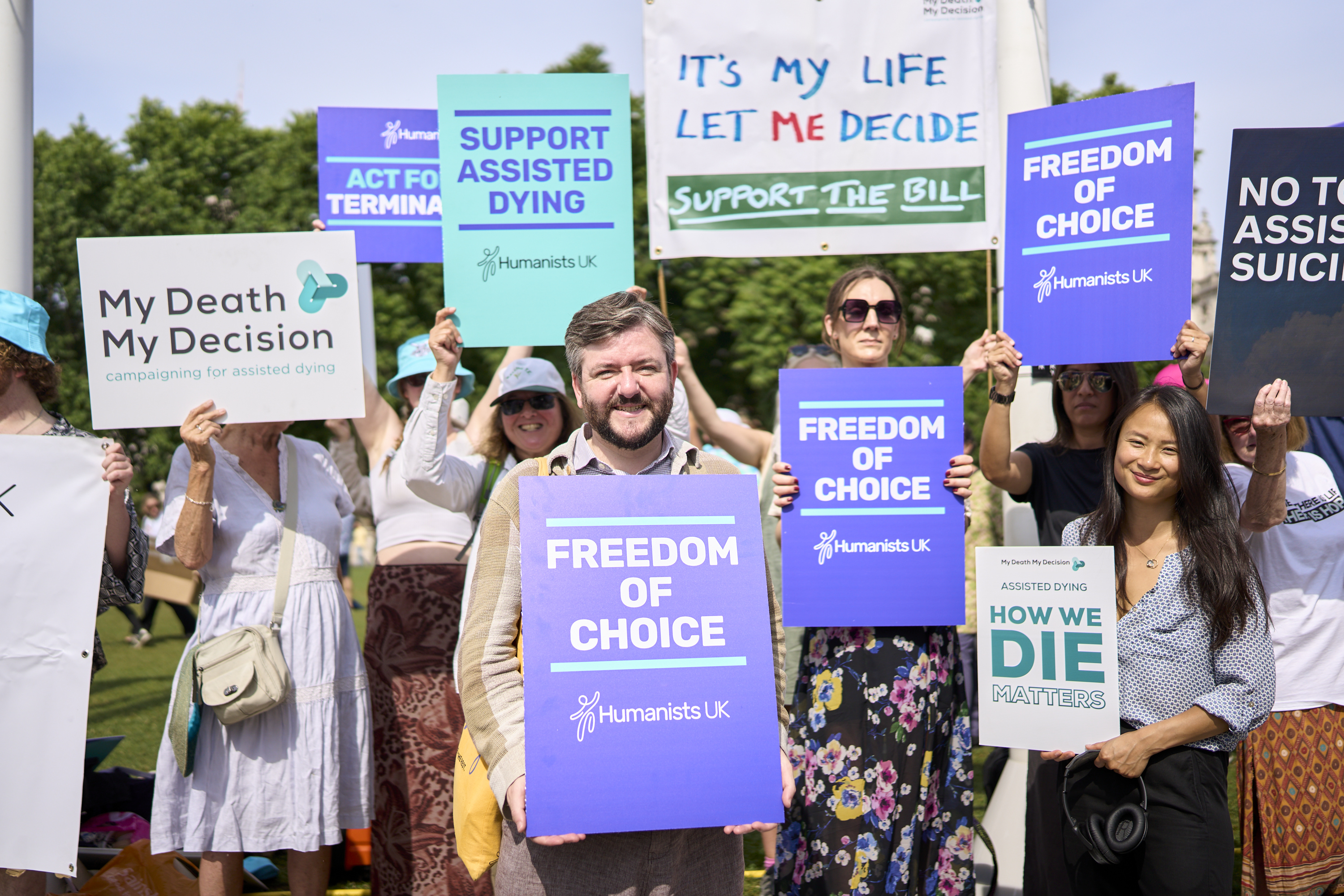
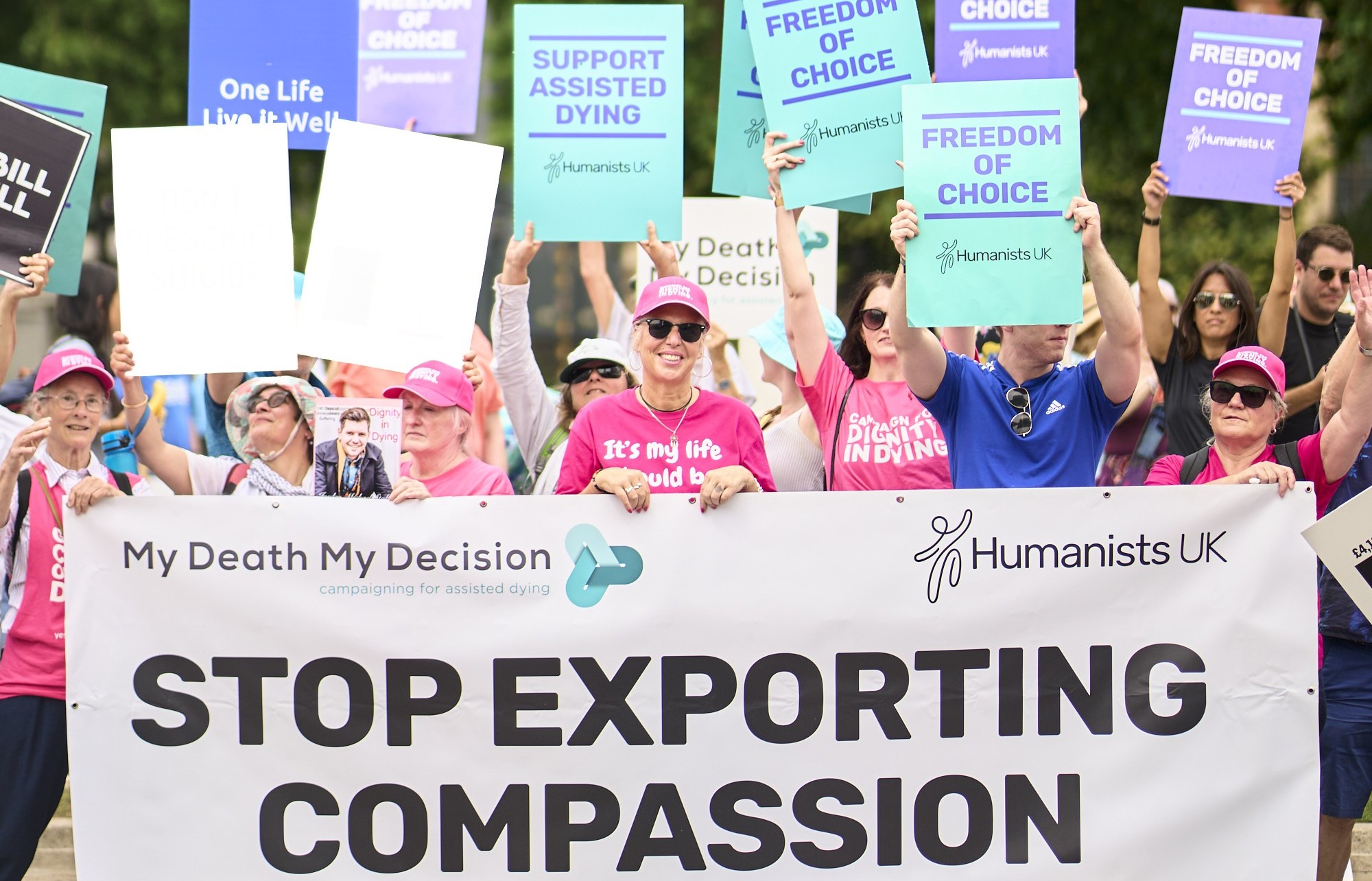
Humanists UK have people and their loved ones who would be affected by this change available for the press.
If you have been affected by the current assisted dying legislation, and want to use your story to support a change in the law, please email campaigns@humanists.uk.
Humanists defend the right of each individual to live by their own personal values, and the freedom to make decisions about their own life so long as this does not result in harm to others. Humanists do not share the attitudes to death and dying held by some religious believers, in particular that the manner and time of death are for a deity to decide, and that interference in the course of nature is unacceptable. We firmly uphold the right to life but we recognise that this right carries with it the right of each individual to make their own judgement about whether their life should be prolonged in the face of pointless suffering.
We recognise that any assisted dying law must contain strong safeguards and the international evidence from countries where assisted dying is legal shows that safeguards can be effective. We also believe that the choice of assisted dying should not be considered an alternative to palliative care, but should be offered together as in many other countries.
Humanists UK is the national charity working on behalf of non-religious people. Powered by over 150,000 members and supporters, we advance free thinking and promote humanism to create a tolerant society where rational thinking and kindness prevail. We provide ceremonies, pastoral care, education, and support services benefitting over a million people every year and our campaigns advance humanist thinking on ethical issues, human rights, and equal treatment for all.
Humanists UK and My Death, My Decision are both members of the Assisted Dying Coalition, along with Friends at the End, Humanist Society Scotland, and End of Life Choices Jersey.