

Nathan Stilwell is our Assisted Dying Campaigner. He drives our work both inside and outside Parliament: briefing parliamentarians, appearing regularly in the media, and taking a leading role at our assisted dying rallies. Nathan works to support activists across the UK and internationally, and is also the Communications and Campaigns Manager for My Death, My Decision. We caught up with Nathan ahead of the Terminally Ill Adults (End of Life) Bill’s Second Reading in the House of Lords happening 12 September.
What are your expectations for the House of Lords debate?
There are nearly 200 members of the House of Lords currently down to speak at the debate. This will likely be one of the biggest debates in the House of Lords in recent years, perhaps ever. We expect a large number of people to be watching online, as well as lots of news coverage and interest. Hopefully, the debate, similar to what it was in the House of Commons, will be respectful and Parliament at its best – this certainly doesn’t feel like the right topic for shouting or dirty tricks – but we won’t know until the day itself.
How could peers potentially block or delay the Bill?
In its simplest terms, they can start the debate with a proposal to chuck the whole thing out. This would be viewed incredibly negatively, but it is still a possibility. After the next debate, possible tactics will be either to propose wrecking amendments or to ‘timeout’ the Bill. Wrecking amendments can be simple or complicated, but in essence, they will stop the Bill from working. An example that we saw at the Committee Stage in the House of Commons was one amendment that meant the Bill was only accessible for people with one month left to live. Another increased the waiting period to over a month so that even if the law passed, it would be useless.
Timing out is a bit more complicated. These types of bills can normally only be discussed on Fridays. If the Bill doesn’t make it through all the stages before the next King’s Speech, then essentially it’s run out of time and it’s all over. There are ways around that, and it will likely become obvious if a peer is deliberately slowing things down. What’s different about this Bill is that the public, and even MPs, are watching incredibly closely. If the Bill were to fail due to something like this, so many people would be furious.
What role, if any, are the bishops likely to play?
The House of Lords includes 26 archbishops and bishops of the Church of England. They have typically spoken against social issues like same-sex marriage, abortion and assisted dying. The Archbishop of York, Stephen Cottrell, has been outspoken against assisted dying. We expect the bishops, who collectively represent the Church of England as an organisation, to campaign against assisted dying.
But the wider picture vis a vis religion is more complicated picture than that. The former Archbishop of Canterbury, George Carey, supports the Bill; some Christian, Muslim, Sikh, Jewish and Hindu MPs voted in favour in the Commons, and around 7 in 10 people who follow a religion would support assisted dying. People of all religions or beliefs support the right to a dignified choice. We know internationally where assisted dying is legal, people of all religions and beliefs have had assisted deaths. We hope politicians respect that.
What does the latest evidence tell us?
New extensive research from the Nuffield Trust shows that in jurisdictions where assisted dying is legal, ‘people can find the process reassuring and that it can give them a sense of control, even if they do not go on to have an assisted death.’
Much of the media attention around the report has focused on a quote from Nuffield that says ‘With assisted dying remaining a contested issue, and our health and care systems struggling under immense pressure, implementing a new service won’t be straightforward.’ The quote goes on to say: ‘However, other countries provide valuable lessons which can help policy makers to make good choices as the bills legalising assisted dying continue their parliamentary journeys.’ Some media appear to have taken the ‘won’t be straightforward’ part in isolation and made it sound like it might be too hard for us to bother with.
It’s been very clear there’s been a sort of ‘air war’ in the media when it comes to assisted dying. It’s been very hard to break through it, so a lot of our work is trying to cut through that noise and present both the evidence, but also the real human stories of dying people who want that choice.
How is this Bill different from previous assisted dying bills?
This Bill is longer, more complicated, with more safeguards, but also more steps that the dying person has to go through. There’s extra domestic abuse training for doctors, there’s a multi-disciplinary panel, there’s a new life sentence for coercion, and there’s a new oversight body. What’s also different about this process has been that the House of Commons is also far younger, far less religious, and far more diverse than any other parliament we’ve ever seen in our history – in other words, more representative of the country as a whole. This has definitely laid the groundwork for change. That will not necessarily be the same for the House of Lords, so let’s see where we end up.
What are the most common myths or misconceptions about this Bill, and what should people look out for in the debate?
As I mentioned, there’s definitely an ‘air war’ going on around the Bill, so there’s lots of misinformation going around. Two key ones stand out. Firstly, the myth that the Bill has been rushed or hasn’t had enough scrutiny. This is very demonstrably untrue. The Bill has received over 100 hours of debate from politicians. We think this is more than any Bill of this kind has received, and is more than most Government Bills.
Secondly, there is the myth that disabled people don’t support assisted dying. Multiple polls from different, credible organisations show that disabled people often support the law at a higher rate than non-disabled people. There’s definitely nuance here, as I believe it is true that many disabled people have concerns and want to see strong safeguards, but overall, that doesn’t mean that they don’t want to see the law changed.
You’re leading our rally outside Parliament on 12 September. What would you say to someone who supports assisted dying, but hasn’t yet decided whether to come along – why is it crucial they be there?
Members of the House of Lords aren’t elected, and some will think they can ignore the public and rise above the noise. But that doesn’t mean that they aren’t accountable to the people, nor does it mean they can ignore the suffering and pain that too many people go through at the end of life. A large demonstration outside Parliament shows them that the people are watching. This isn’t a normal debate, and everyday people are following this more closely than a lot of different political events. We need to show the House of Lords a clear message – we deserve the freedom to choose.
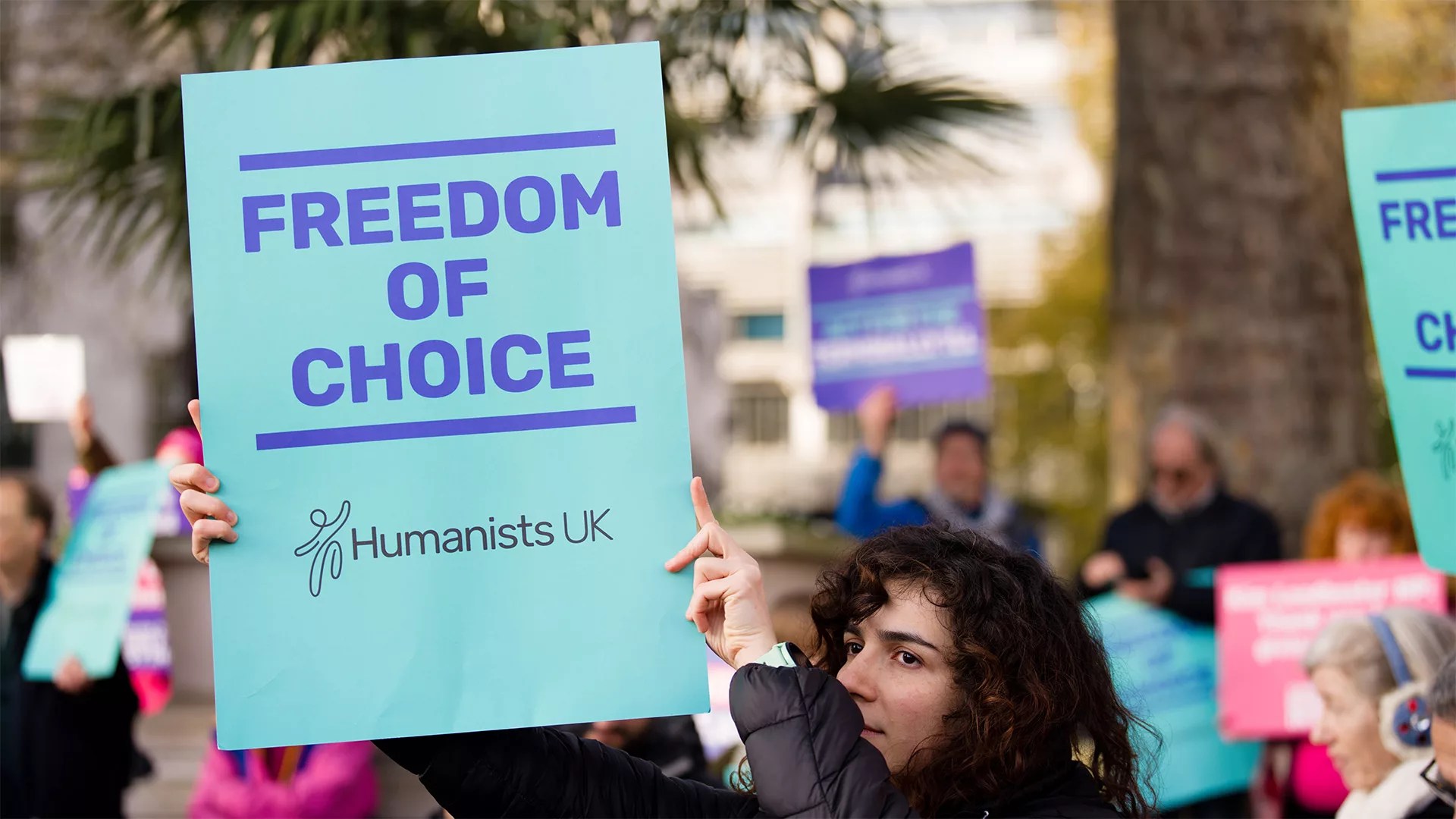
Assisted Dying Rally | House of Lords Second Reading
12 September 2025, 08:00
This event is now closed.
Notes
If you have been affected by the current assisted dying legislation, and want to use your story to support a change in the law, please email campaigns@humanists.uk.
Humanists UK is the national charity working on behalf of non-religious people. Powered by over 150,000 members and supporters, we advance free thinking and promote humanism to create a tolerant society where rational thinking and kindness prevail. We provide ceremonies, pastoral care, education, and support services benefitting over a million people every year and our campaigns advance humanist thinking on ethical issues, human rights, and equal treatment for all.
Humanists UK is a member of the Assisted Dying Coalition, along with My Death, My Decision, Friends at the End, Humanist Society Scotland, and End of Life Choices Jersey.