
Janet Ellis MBE
Broadcaster, actor, writer, and President of Humanists UK
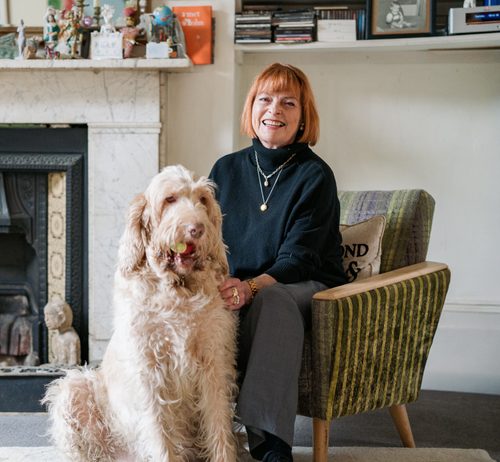
‘This one life, this short but illuminating span, gives us all an opportunity to look for the good in others and to explore the furthest reaches of our ability to create, to investigate, to connect, and to care. I don’t think we are following a path ordained by a higher spirit. I look to the future not as an amorphous destination beyond death but a direct consequence of our daily, present contribution.’
Janet Ellis MBE began her career in acting, having trained at the Royal Central School of Speech and Drama. Born in Chatham into a serving army family, she attended seven schools before leaving at 17 to pursue her passion for performance. Her professional debut came just three weeks later in a Jackanory Playhouse, followed by appearances in theatres nationwide and roles in classic television dramas including Doctor Who, The Sweeney, and four series of the BAFTA-winning Jigsaw.
Janet became a household name presenting Blue Peter from 1983 to 1987. Her tenure on the show featured memorable highs – quite literally, as she set the female Civilian Freefall record – and challenging moments, such as handling a live tarantula on air.
Since her time on Blue Peter, Janet’s career has spanned television, radio, and theatre, covering diverse subjects from gardening to blood donation. In 2016, she was awarded an MBE for services to theatre and charity. She is a dedicated ambassador for Maggie’s cancer centres, Reading Force, and Marie Curie, and serves as a trustee for the National Youth Theatre.
A popular writer for newspapers and magazines and a former agony aunt, Janet published her debut novel, The Butcher’s Hook, in 2016, followed by How It Was in 2019. Janet also hosts the podcast Twice Upon a Time, where guests ranging from Michael Morpurgo to Nick Mohammed and Lorraine Kelly discuss their favourite childhood books.
She has three children, six grandchildren, and a dog called Angela.
Janet appeared on Humanists UK’s podcast What I Believe in 2020 to discuss her humanist outlook and approach to life:
‘We don't know what’s going to happen next and often even if you did go back and think “If I was standing at that particular crossroads, would I make that decision again?”... often, if I’m honest, I would, even knowing what happened, because there’s something in the way that it happened that opens up other avenues for you, that changes your thinking or your relationships. The forces in my life I most believe in are first of all, love and kindness, and then humour, because I can’t imagine a world without that.’
The same year, she shared her experience of coping with grief and isolation during lockdown for a YouTube short produced for an NHS mental health campaign alongside Humanists UK:
‘My husband died last year in July at the beginning of lockdown. Although he had cancer, we said to each other, how lucky we were to have each other, to be here, to have a garden, to have family and friends close by, to be very supported. And after he died, I had to cope with grief and isolation, and I can tell you, they're very noisy companions. To help me, and to understand that cacophony in my head, I remembered that as a humanist, I believe passionately in people. I believe in what we are capable of. I can see all around me the things we've already done. I believe in our joint experience and in our singular ability to find our way to love, happiness, beauty, and a sense of inner strength, which doesn't last forever – it might be momentary – but when it happens, is something that you can build on. It's certainly what's getting me through.’
In 2021, Janet was a guest on BBC Radio 2’s What Makes Us Human on which she discussed her humanist beliefs with presenter Jeremy Vine. In 2023, she appeared on BBC Radio 4’s Beyond Belief to discuss her journey to humanism, starting at childhood, alongside Vice President of Humanists UK Professor Alice Roberts and co-founder of the Association of Black Humanists, Lola Tinubu. She said:
‘The default during my childhood was very much that if you were going to have a faith, it would involve practising that faith, convening with people who thought the same as you, and therefore, if you didn’t have that faith, you needed to find yourself a club – you needed to find yourself like-minded people. That didn’t happen for a long time for me.
‘In those days, school assemblies were very much based around the Church of England and the idea that this bit was the rehearsal, that eventually you get to a much better place and it would be what you imagine it to be. But I can remember thinking when I was very little, “that doesn’t feel right to me”.
‘Later on, I wanted it known that I am not just “this is what I think”, but “my comfort is this, my absolute comfort”. I take as much comfort from what I think about how people are when they die as other people might about reuniting with them later. And when I started investigating humanism, what I liked about it is the robust sensibility to it. There’s no end to these conversations but the starting point is “Here we all are, what can we do about this, how can we make it better, how can we be kinder, how can we glory in what people do and the astonishing breadth and depth and majesty of nature for ourselves?” It has become deeper as I’ve gotten older.
‘To me, humanism is much more of a choice [than atheism]. Atheism does feel a bit clunky in a way, it feels like you’ve made a choice to deny them [those with religion], and that’s not it. I’m not saying “I see what you’re thinking, that’s not for me.” I’m saying categorically “I know what I think, can I find some other folk who feel the same?”’
Asked about the place of ritual and community in the life of a humanist, Ellis said:
‘I’m always loath to say ritual because it implies something beyond choice, but I think I am a creature of habit. To me, habit is a good thing. We don’t have an appointed time of meeting but there are plenty of things on offer that I enjoy. It gives me a quiet celebration of the fact we are pack animals. It’s nice to know other people think the same. Plus – I’m not going to name names here – but when I look down the list of Humanists UK patrons, they were pretty much my ideal dinner party companions.’