

The House of Lords will talk out the Assisted Dying Bill, causing it to fail, unless they speed up the debate. Humanists UK and My Death, My Decision are dismayed that the unelected House is frustrating the will of the House of Commons, as well as the overwhelming majority of the public. On the second day of debate for the Committee of the Whole House for the Terminally Ill Adults Bill, peers debated only one group, representing 21 amendments. Meanwhile, 82 new amendments were added between today’s debate and the first day of debate a week ago.
Last week, we revealed that at their current pace, it would take two decades to debate all the current amendments. More amendments were introduced in the past seven days than were debated in the first two days of debate, which together lasted nearly ten hours. There are only two more days of debate scheduled this year.
The Bill must pass all stages in the Lords and Commons before Spring 2026, or it fails. At the current rate of debate, it will not pass.
We are far from seeing the end of amendments, too. Peers usually have until two days before a Clause is debated to add new amendments to it. After two days of debate, peers are still debating Clause 1. With 59 clauses in total, most won’t be reached for some time.
Analysis by Humanists UK and My Death, My Decision has shown that seven of the most vocal opponents to the Bill have put forward over 600 amendments between them.
More than 900 amendments have been put forward by opponents of the Bill, and fewer than 100 have been put forward by supporters of the Bill. Lord Falconer, the sponsor of the Bill, has put forward 35 amendments. The Hansard Society have pointed out that the Bill has an extraordinary number of amendments for a Bill of this size, with an average of 21 amendments per page; the next highest bill has only 5.29 amendments per page.
Help us support the Assisted Dying Bill and stop the filibustering in the House of Lords. Raise the issue and send a message to peers today.

A guide to filibustering in the House of Lords
Unlike the House of Commons, the House of Lords does not usually have closure motions that force debates to end. There have been several examples of Bills with popular and parliamentary support running out of time.
Henry Smith MP’s Hunting Trophies (Import Prohibition) Bill in 2023 passed all stages in the Commons with cross-party and government support. In the Lords, a small group of pro-hunting peers tabled several amendments and refused to have them grouped, leading to long speeches on each. No further time was allotted before the session ended, so the bill ran out of time and fell. That Bill was only three pages long.
There have been accusations of filibustering in the past by the Lords over bills on hereditary peers, football regulation, and Brexit.
The Hansard Society has outlined five possible options to create more time for the Bill, but none of these solutions work if more amendments are proposed than can be debated.
Wrecking, duplicating and delaying tactics
Opponents to the Bill will claim that a bill of this nature requires additional scrutiny. They may also claim that some amendments are probing, designed to encourage debate. However, some amendments are increasingly nonsensical, wrecking, and clear efforts to undermine the Bill.
Baroness Coffey has put forward an amendment stating that a person can only have an assisted death if they have not left the UK in the past twelve months. This would prevent anyone who had recently been on holiday from having an assisted death, and would also be unenforceable.
Lord Goodman of Wycombe has put forward several amendments to increase the number of assessment stages from two independent doctors and a panel to five doctors and a panel, the fifth being a geriatrician. This would be impossible to navigate for a terminally ill person with fewer than six months to live, and a significant minority of applicants for an assisted death would be under the age of 60 (15% of applicants in Victoria, Australia are).Four amendments, Baroness Fox of Buckley (Amendment 150), Lord Goodman of Wycombe (Amendments 151 & 156), Lord Moylan (Amendment 152), and Lord Rook (Amendment 154) are almost identical and attempt to do the same thing. They aim to introduce a ‘gag clause’ to stop doctors discussing assisted dying with patients. Similar such amendments have repeatedly been discussed and voted down by the House of Commons at both the Committee and Report stages. They may be individually debated in the Lords in turn, if the sponsors want them to be.
Louise Shackleton, who was under police investigation for accompanying her husband to Dignitas, said:
‘I sat by my husband’s side as he made the most heartbreaking and dignified decision of his life. He was suffering, and the only mercy left was to travel to Switzerland to end that suffering. For loving him enough to go with him, I was treated like a criminal. The system failed him, and it failed me. No one should have to choose between compassion and the law. We need change, not more delays, not more political games, but real, humane change.’
‘To see hundreds of wrecking amendments being tabled, many by the same small group of peers who’ve always opposed this Bill, is gut-wrenching. This isn’t scrutiny, it’s sabotage. While they play politics, people like my husband are forced to suffer, or die alone in another country. How can that possibly be right? The public supports this Bill. The Commons supports this Bill. These tactics are an insult to the democratic process and to every family that has lived through this pain.’
Nathan Stilwell, Assisted Dying Campaigner at Humanists UK, said:
‘When an unelected chamber deliberately stalls a bill backed by the elected House of Commons and the public, it does more than delay legislation; it undermines the very principle of representative democracy. This is not scrutiny; it is sabotage disguised as procedure.
‘Every procedural delay, every stalling tactic, traps people in a system that denies them agency and compassion at the moment they need it most. The status quo forces suffering, strips families of dignity, and exports choice to foreign countries. It is not neutral; it is actively harmful. To preserve this system in the name of process is to ignore the real human cost paid by those who cannot afford to wait.’
Dave Sowry, Board Member of My Death, My Decision, said:
‘Despite polite pleas to focus on their proper function, the House of Lords spent a second day going almost nowhere. The concerted effort to block its progress by a very small number of peers, who are all against the Bill as a matter of principle, continues.
‘They ignore the perspective of those the Bill is designed for, people at the end of their lives. Its aim is to improve the quality of those last weeks, and having accompanied my wife to Dignitas for an assisted death, I know how precious those weeks are.
‘The process must be as simple as possible for the vast majority of straightforward cases, whilst being robust and safe for the remaining tiny minority of complex cases. This small group of peers must not be allowed to undermine the will of Parliament and the hopes and wishes of the public.’
Notes
For further comment or information, media should contact Nathan Stilwell at nathan@humanists.uk or phone 07456 200033. (media only)
Humanists UK is making the following photos available to the media to use – credit to Simona Sermont/Humanists UK – 1, 2, 3, 4, 5.
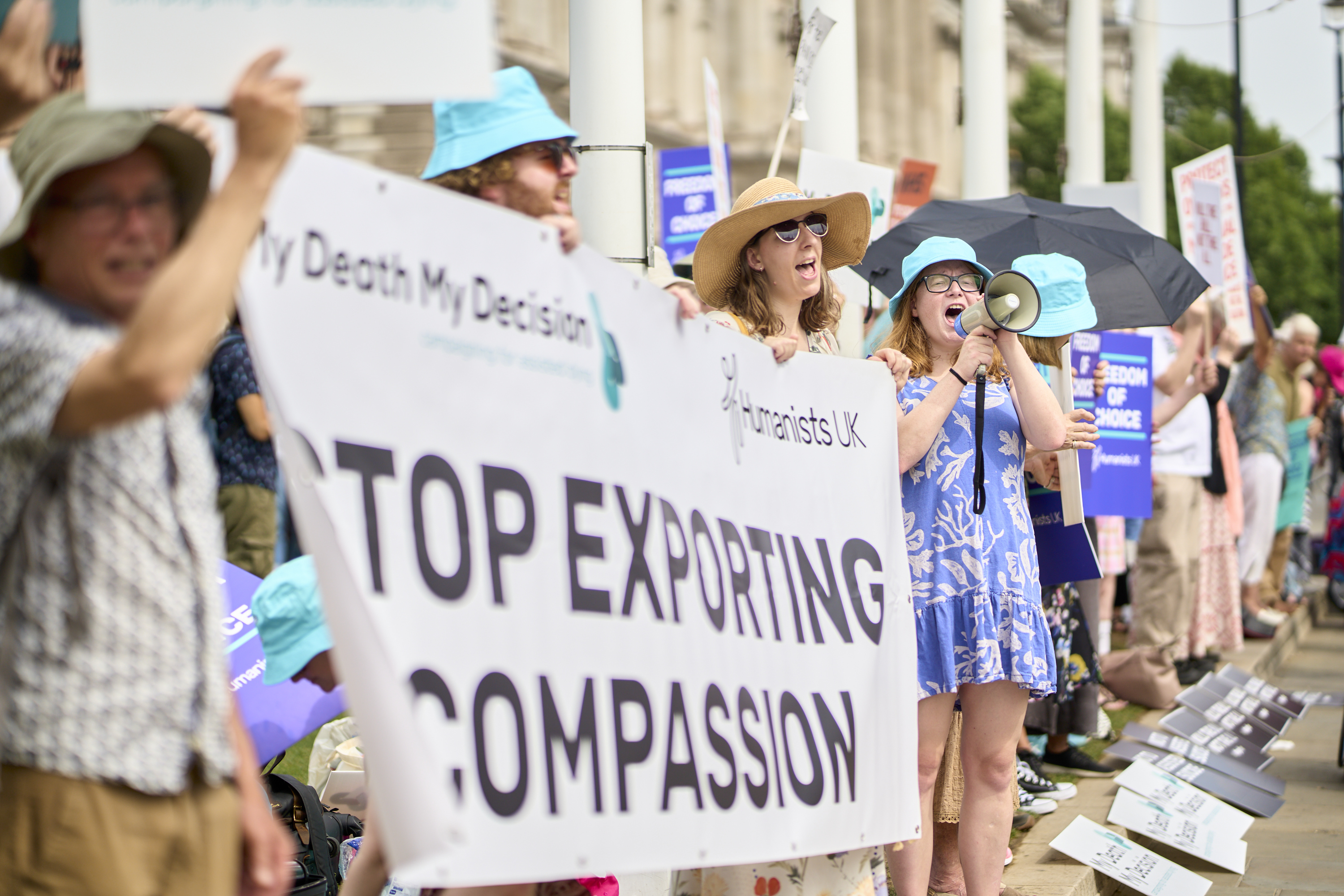
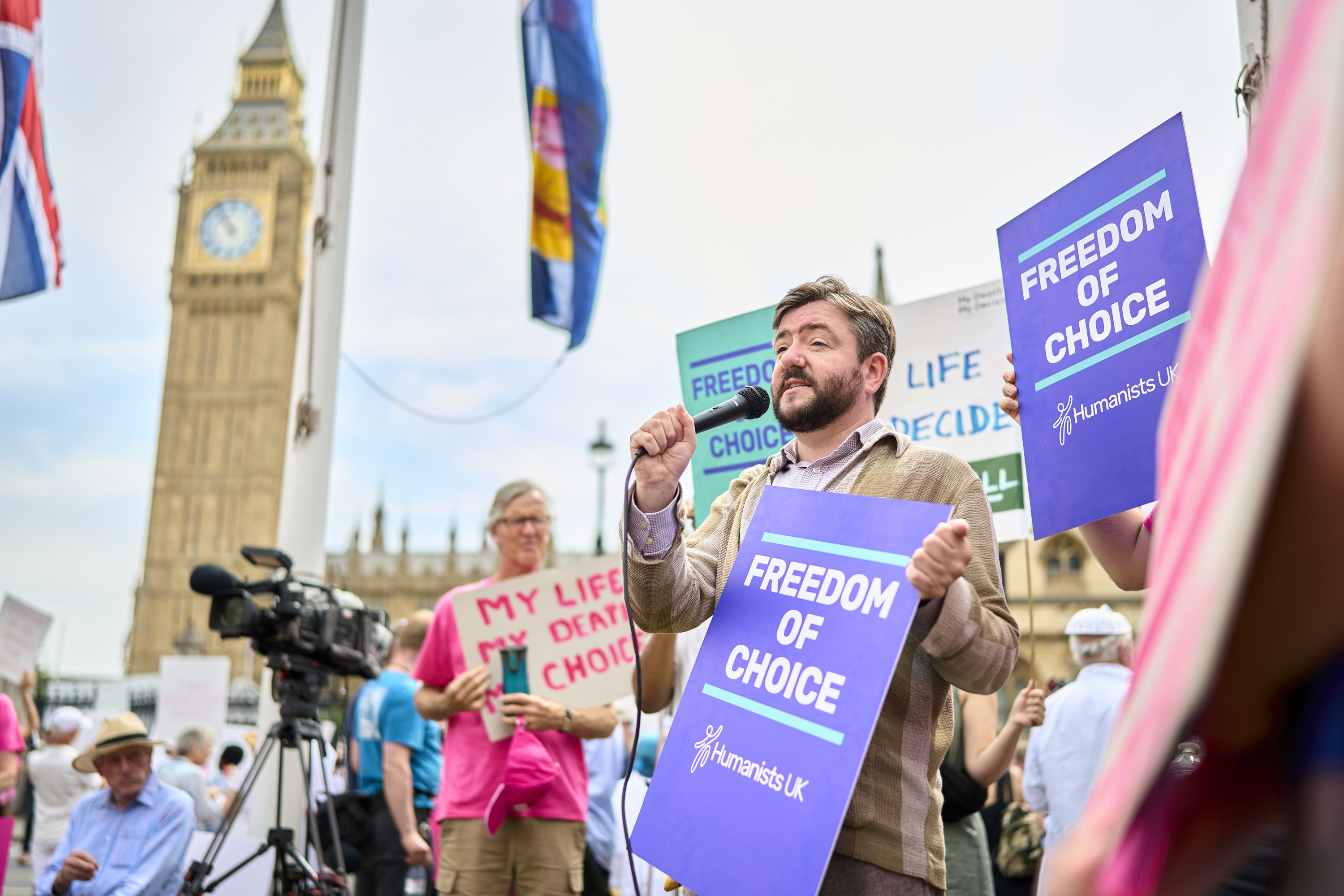
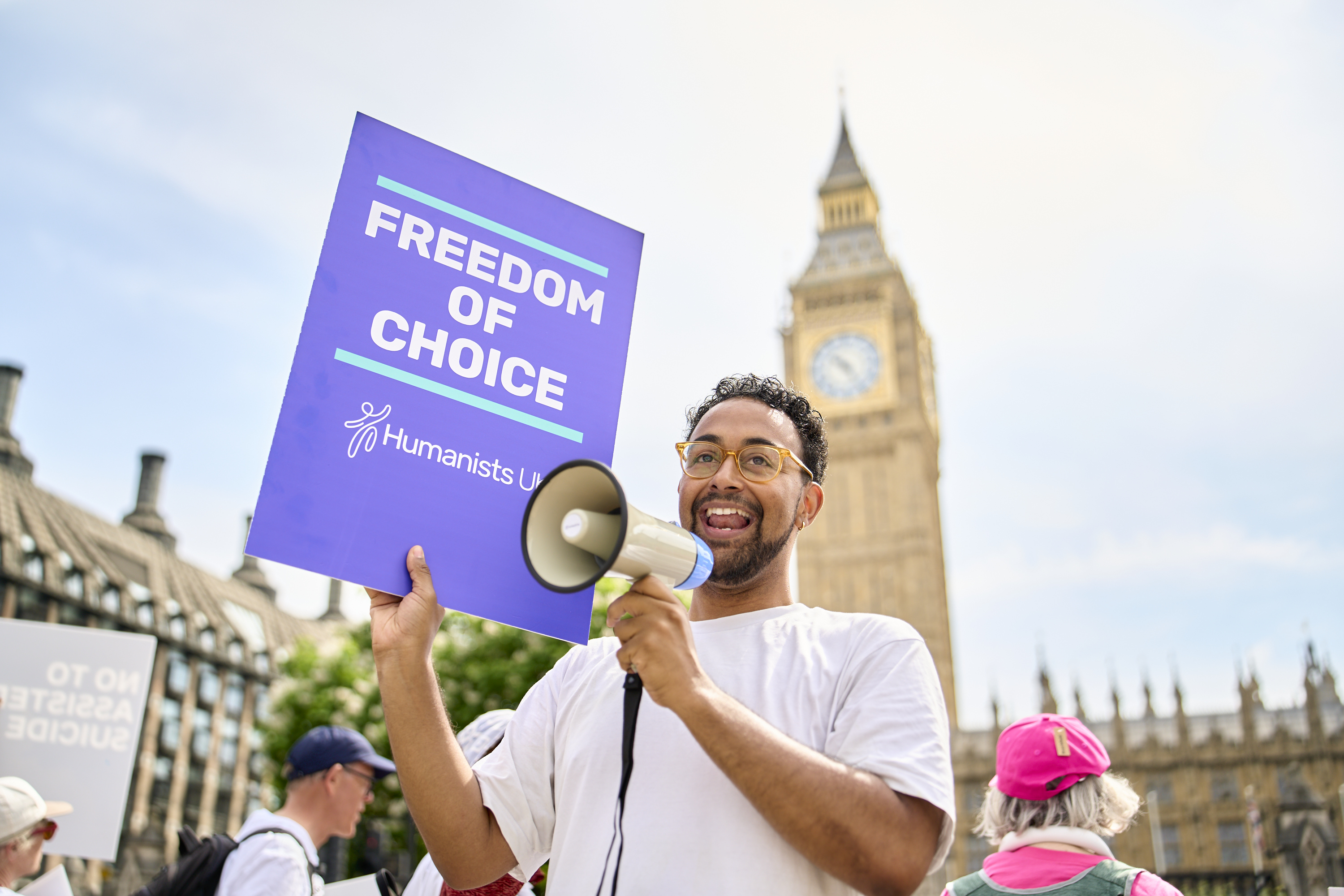
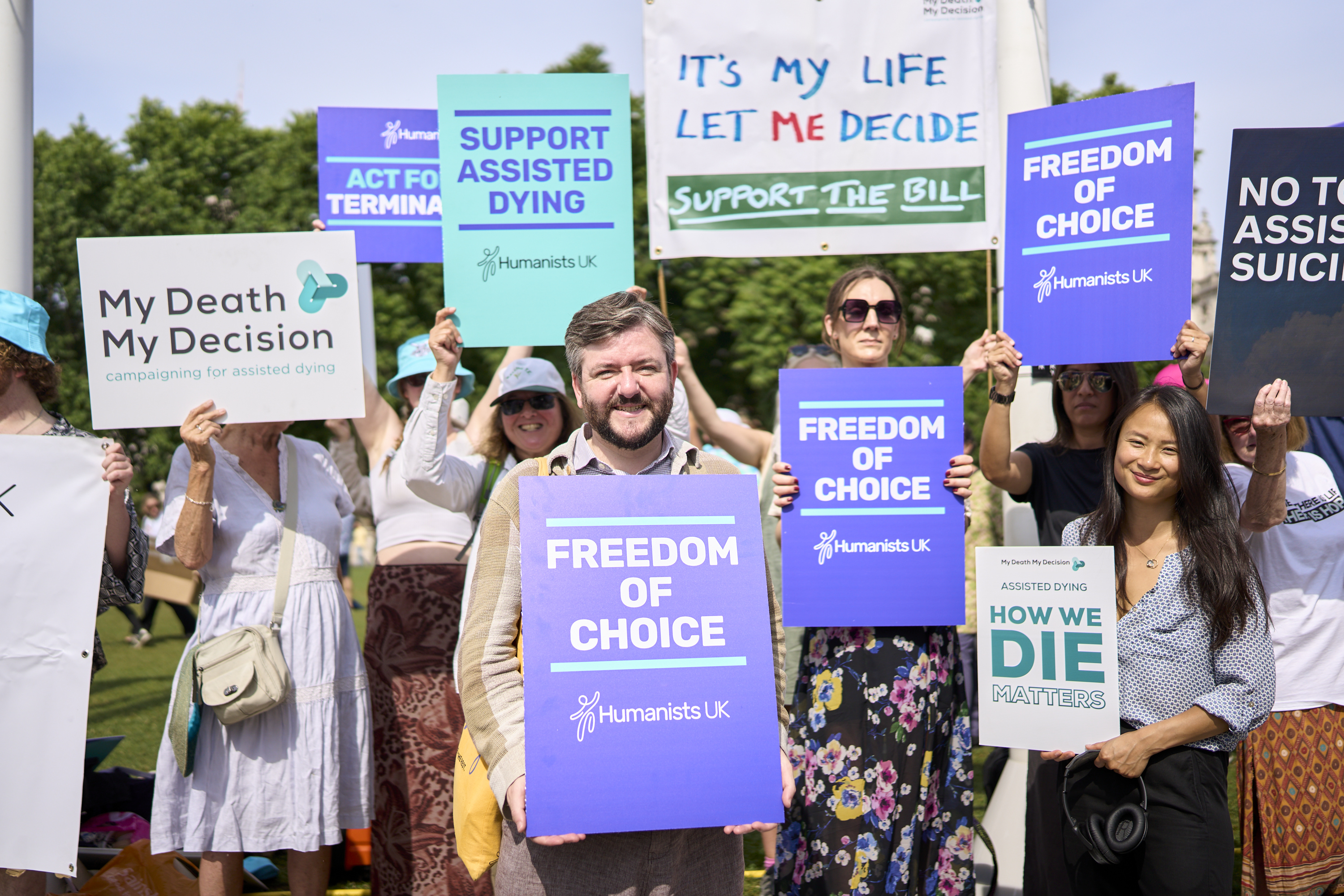
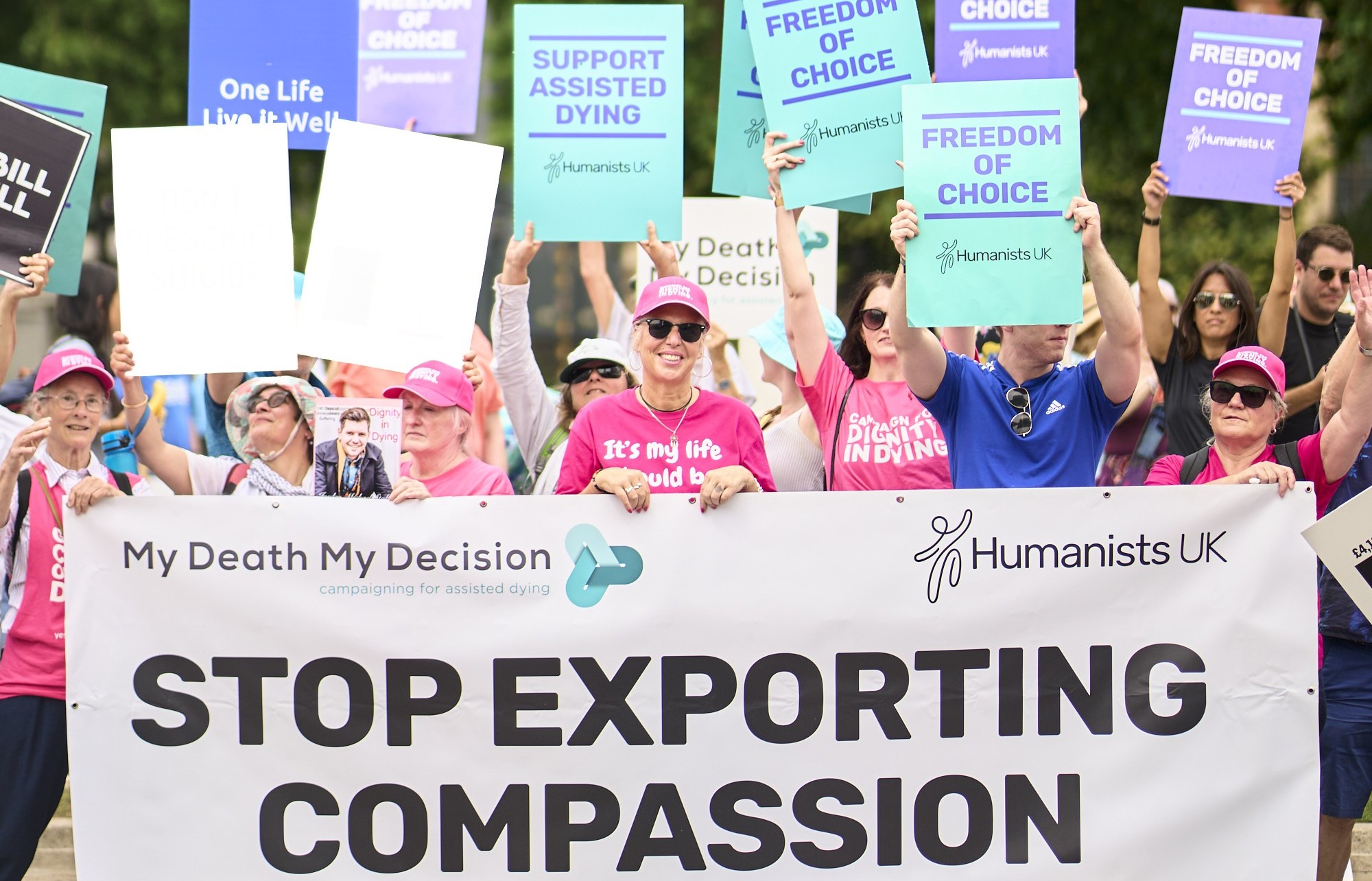
Humanists UK and My Death, My Decision have people and their loved ones who would be affected by this change available for the press.
If you have been affected by the current assisted dying legislation, and want to use your story to support a change in the law, please email campaigns@humanists.uk.
Humanists defend the right of each individual to live by their own personal values, and the freedom to make decisions about their own life so long as this does not result in harm to others. Humanists do not share the attitudes to death and dying held by some religious believers, in particular that the manner and time of death are for a deity to decide, and that interference in the course of nature is unacceptable. We firmly uphold the right to life but we recognise that this right carries with it the right of each individual to make their own judgement about whether their life should be prolonged in the face of pointless suffering.
We recognise that any assisted dying law must contain strong safeguards and the international evidence from countries where assisted dying is legal shows that safeguards can be effective. We also believe that the choice of assisted dying should not be considered an alternative to palliative care, but should be offered together as in many other countries.
Humanists UK is the national charity working on behalf of non-religious people. Powered by over 150,000 members and supporters, we advance free thinking and promote humanism to create a tolerant society where rational thinking and kindness prevail. We provide ceremonies, pastoral care, education, and support services benefitting over a million people every year and our campaigns advance humanist thinking on ethical issues, human rights, and equal treatment for all.
My Death, My Decision is a grassroots campaign group that wants the law in England and Wales to allow mentally competent adults who are terminally ill or intolerably suffering from an incurable condition the option of a legal, safe, and compassionate assisted death. With the support of over 3,000 members and supporters, we advocate for an evidence-based law that would balance individual choice alongside robust safeguards and finally give the people of England and Wales choice at the end of their lives.
Humanists UK and My Death, My Decision are both members of the Assisted Dying Coalition, along with Friends at the End, Humanist Society Scotland, and End of Life Choices Jersey.