

The House of Lords Select Committee on the Terminally Ill Adults (End of Life) Bill held their fourth day of oral evidence, during which it heard evidence from a range of mental health, domestic abuse, and disability rights experts. My Death, My Decision and Humanists UK have raised concerns about the potential bias of the Committee and the oral evidence that has been chosen.
First session: Domestic abuse and mental health
When asked about what safeguards exist currently, without the Assisted Dying Bill, concerning domestic abuse and the terminally ill, Cherryl Henry-Leach, Chief Executive of Standing Together Against Domestic Abuse, told the Committee:
‘We believe very firmly that there are currently no checks and balances to ensure appropriate levels of safeguarding, and that includes a person’s decision, not being influenced by a perpetrator.
‘We are also concerned that those who are diagnosed, and that diagnosis has been confirmed as terminal, if there is pre-existing domestic abuse prior to that diagnosis, may be coerced to feel that their condition or illness is a burden to their perpetrator because of the dynamic of the coercive control that they have suffered prior to that diagnosis. So for me, at the moment, I would feel that it’s an unsafe system that we have.’
Dr Sarah Hughes, Chief Executive at MIND, told the Committee:
‘I would concur, I think that we absolutely know that we have limited safeguards, actually, for people who want to leave the country for assisted dying support. We also know that, you know, many people do take their own lives. So we also know that that’s nearly 6,000 people a year.
‘It’s for that very reason that we think that in order to provide legislation that allows it in this country, all of the levers and safeguards that we have would need to be developed and evolved significantly to ensure those safeguards were in place. We have coercive control legislation, and I think that’s incredibly important. Of course, that’s still fairly new in terms of the world of health and social care, criminal justice, and so on and so on.’
Professor Jane Monckton-Smith OBE, Professor of Public Protection at The University of Gloucestershire, opposes the Bill. She told the Committee:
‘I’m very pleased to see that I think domestic abuse and coercive control are being taken very seriously. That’s really good. But I have not changed my mind on the Bill thus far, because having worked in this area for a very long time now, most of the domestic homicide reviews, for example, and when things go badly wrong, they will say: “Let’s give them more training. Let’s give them more training.” I think throwing that at something clearly does not work.’
What international evidence exists about assisted dying and domestic abuse
The Terminally Ill Adults Bill contains extensive new safeguards to protect people from coercion, such as multiple consultations with healthcare professionals and domestic abuse training for healthcare professionals and panel members. Furthermore, the Bill created new offences, up to life in prison, for coercing someone into an assisted death.
Lesley Storey, the Chief Executive of My Sister’s Place, a charity that supports victims of domestic abuse, said the Bill provides ‘rigorous safeguards where currently there are none’. In an open letter co-signed by more than 40 women, Storey said the ‘risk of coercion for terminally ill women… thrives in the absence of oversight, where there are no safeguards, checks, or balances’.
Assisted dying rates in every jurisdiction where it is legal see near equal numbers of men and women applying.
| Jurisdiction | % Men | % Women | Data date range |
|---|---|---|---|
| Netherlands | 50.8% | 49.2% | 2023 |
| Belgium | 49.4% | 50.6% | 2022 |
| Canada | 51.2% | 48.8% | 2022 |
| Oregon (U.S.) | 53.2% | 46.8% | 2024 |
| Washington (U.S. | 52% | 48% | 2023 |
| California (U.S.) | 50.1% | 49.9% | 2023 |
| New Zealand | 49.8% | 50.2% | Nov 2021 – Sep 2024 |
| Victoria, Australia | 52% | 48% | June 2019 – June 2023 |
| Western Australia | 58% | 42% | 2021-2024 |
| Spain | 50.8% | 49.2% | 2023 |
No country has ever found any serious cases of domestic abuse leading to assisted deaths.
Second Session: Disability
Professor Tom Shakespeare, Professor of Disability Research at London School of Hygiene & Tropical Medicine, told the Committee:
‘I think that we must be careful not to be paternalistic. The whole idea of the Bill is to give people at the end of life permission to end their lives, not as an alternative to palliative care, but another tool in the palliative care arsenal. I think the Bill strikes the right balance. I think that it has lots of safeguards, a cooling-off period, a four-year period of implementation. All of these allow a balance between autonomy and protection.’
Support for assisted dying is as high among disabled people as it is among the population as a whole. 75% of disabled people in polls say they support changing the law.
There are multiple safeguards in the Bill specifically for disabled people:
- The Bill requires the Secretary of State to issue codes of practice for the provision of information and support to persons with learning disabilities who are eligible.
- Clause 20 provides that people with learning disabilities, mental disorders, autism, or other ‘substantial difficulties’ in understanding processes or information will have access to an independent advocate to provide support and advocacy on end-of-life care, including access to assisted dying.
- Clause 44 of the bill requires the Assisted Dying Commissioner to set up a disability advisory board to advise on the implementation and impact of the Bill on disabled people.
Alasdair Henderson KC, Commissioner at the Equality and Human Rights Commission, told the Committee:
‘I think there have been good attempts to improve the Bill already to try and deal with some of these issues, the introduction of the in‘I think there have been good attempts to improve the Bill already to try and deal with some of these issues, the introduction of the independent advocate as a possibility. It’s also going to be something that’s very important to build into any codes of practice made under the Bill.’
Baroness Grey-Thompson DBE, former Paralympian and member of the House of Lords, is a strong opponent of the Bill and has so far tabled 24 amendments to it. She told the Committee:
‘Marie Tidball’s amendments around having disabled people on the panel is a step forward. Who that disabled person is and what experience they have – I’m tabling some amendments around that to strengthen that part of it. I think there should be far greater representation for disabled people.’
Ken Ross, Founding Officer at the National Down Syndrome Policy Group, told the Committee:
‘What this Bill has done is it has actually helped bring into the light a lot of deficiencies in other areas and I think it gives us an opportunity to have a look at those deficiencies and go beyond theory and suggest the training to actual practical delivery on the ground.’
How balanced is the Select Committee?
It has been reported that the Committee is weighted against assisted dying, with more opponents of legislation change than supporters. Analysis by Humanists UK and My Death, My Decision suggests that the experts so far called to give evidence consist overwhelmingly of those opposed to assisted dying. Apart from the Bill sponsors and ministers, those called to give evidence consist of three people supportive of assisted dying, nine against, and 20 neutral.
Who else will provide evidence?
The remaining sessions will focus on legal duties, the drugs used and how assisted dying will work in practice. The Health Minister, Stephen Kinnock and Chief Medical Officer, Sir Chris Whitty will give evidence in the last session.
It will not hear from terminally ill individuals or those who have assisted loved ones to die. Clare Turner, a terminally ill person, and Louise Shackleton, who accompanied her husband to Switzerland for an assisted death, have deemed this omission ‘outrageous’.
In today’s session, Lord Markham asked the panel: ‘Do you think in terms of hearing the best evidence, it would be useful for the Committee to hear from people who are terminally ill themselves so they can share their own feelings?’ Dr Sarah Hughes, Chief Executive at MIND, replied:
‘Absolutely and thank you again for saying that. I think it is critical to being able to have a conversation properly about this.
‘Hearing testimony from people who have a terminal diagnosis would give us a level of richness and security in terms of understanding what those final months and moments are like.’
What happens next?
The Select Committee will not produce a report or make recommendations, but will take and publish oral evidence. The Select Committee will conclude by 7 November, and the Bill will then progress to its Committee Stage for detailed line-by-line scrutiny.
The Bill will need to complete its passage through parliament by Spring 2026.
Richy Thompson, Director of Public Affairs at Humanists UK, said:
‘The Select Committee has lacked the voices of those most directly affected: terminally ill people themselves. Without hearing from those facing the end of life, the Committee risks overlooking the urgency and personal realities behind the call for assisted dying. A fair and balanced process must include the perspectives of those whose rights and dignity are at stake.
‘We need an assisted dying law to give a compassionate choice to those who are suffering unbearably at the end of life. No-one should be forced to endure needless pain or travel abroad to die with dignity. With robust safeguards and proper oversight, we can create a law that protects the vulnerable while respecting individual autonomy and humanity.’
Dave Sowry, Board Member of My Death, My Decision, said:
‘There is a wealth of international evidence showing that assisted dying laws can work safely and fairly. In countries like Australia and New Zealand, strong safeguards have protected vulnerable people while enabling dying people facing intolerable suffering to make compassionate end-of-life choices. The data shows that fears of widespread abuse are unfounded, and that legal, regulated systems provide greater protection than the status quo in this country.
‘It is deeply disappointing that the Committee has chosen not to hear directly from terminally ill people or from families who have supported loved ones through assisted deaths abroad. Their lived experience is vital to understanding the real-world impact of our current law. Without their voices, this inquiry risks being one-sided and missing the opportunity to truly reflect the needs and wishes of those most affected.’
Notes
For further comment or information, media should contact Nathan Stilwell at nathan@humanists.uk or phone 07456 200033. (media only)
Humanists UK is making the following photos available to the media to use – credit to Simona Sermont/Humanists UK – 1, 2, 3, 4, 5.
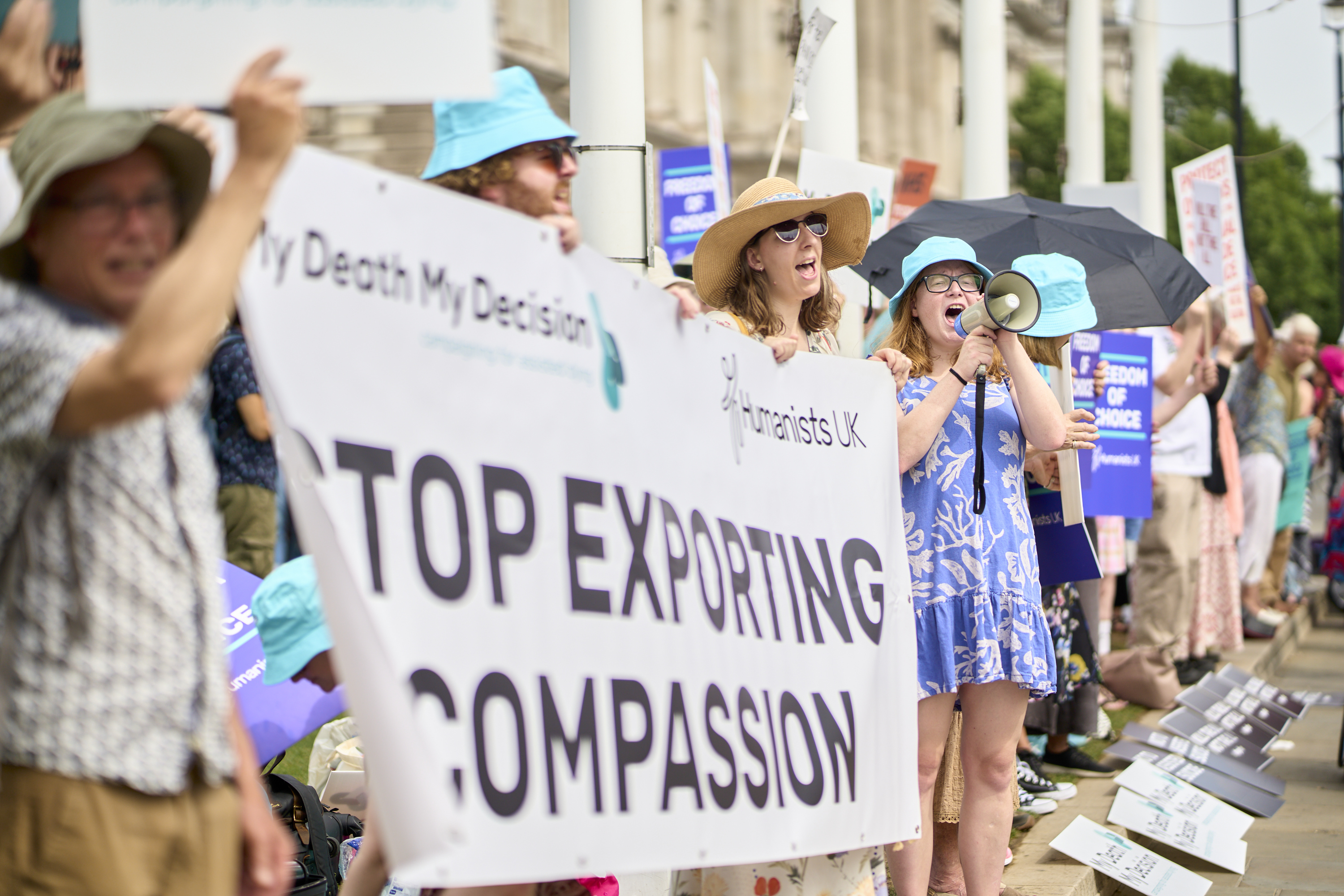
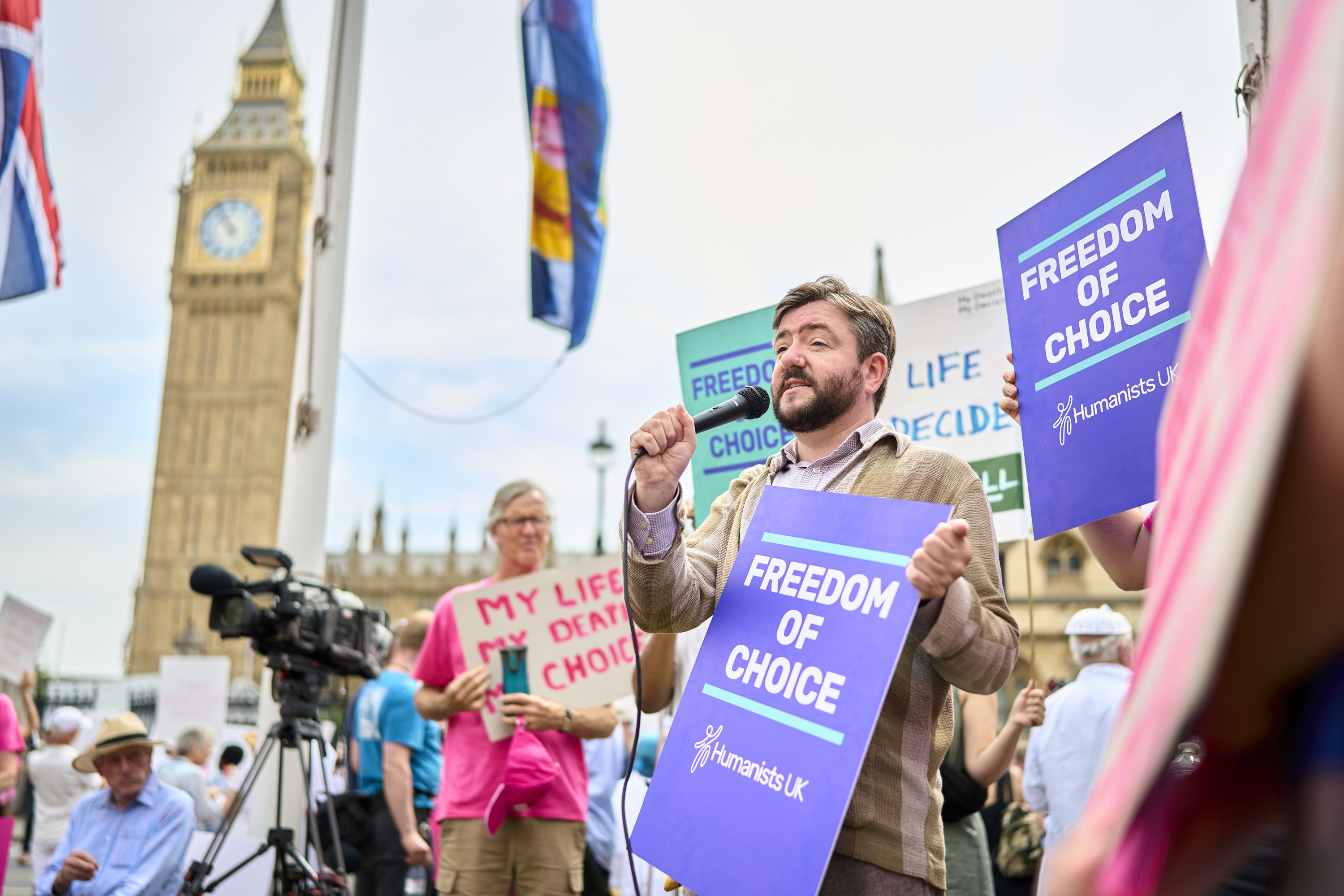
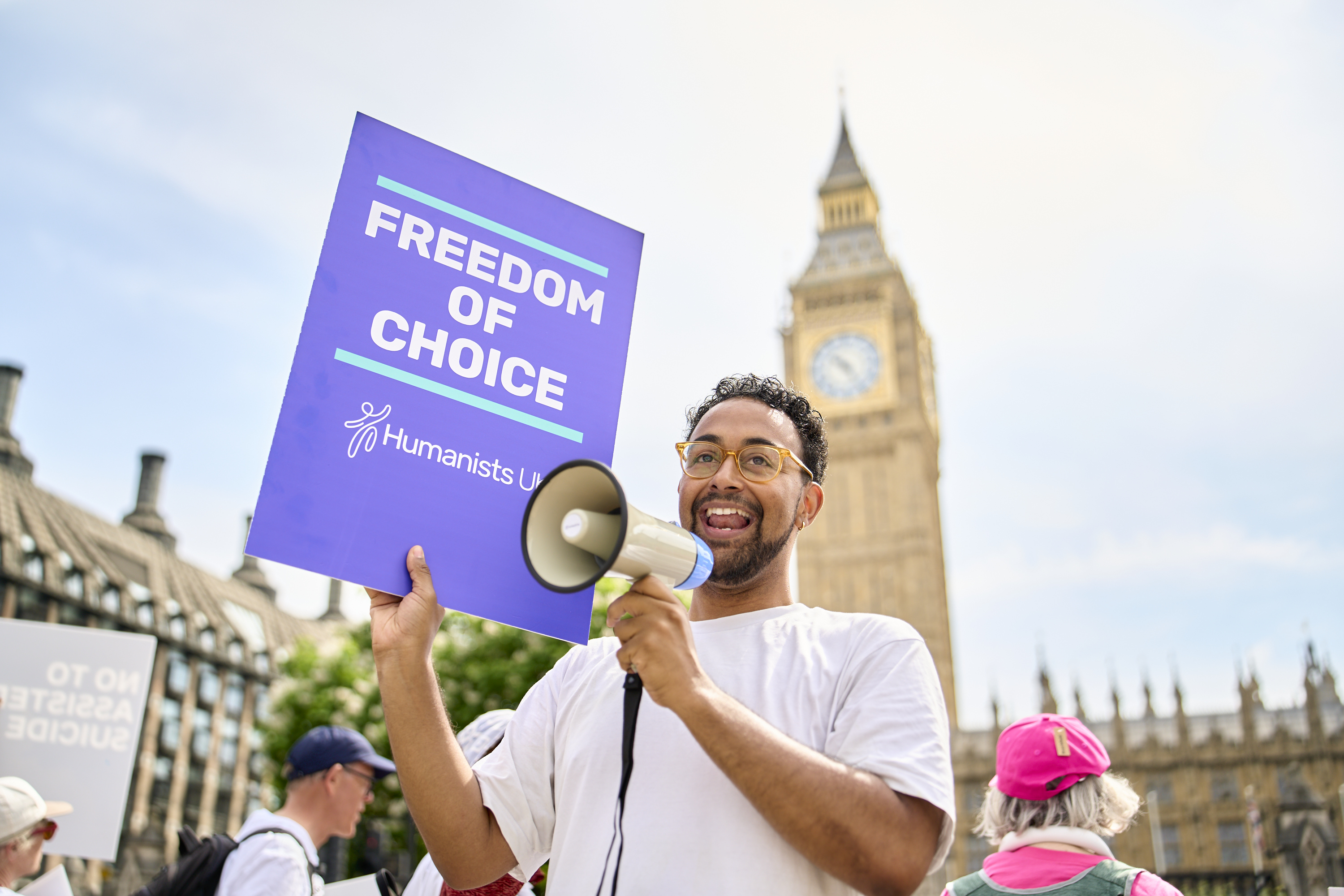
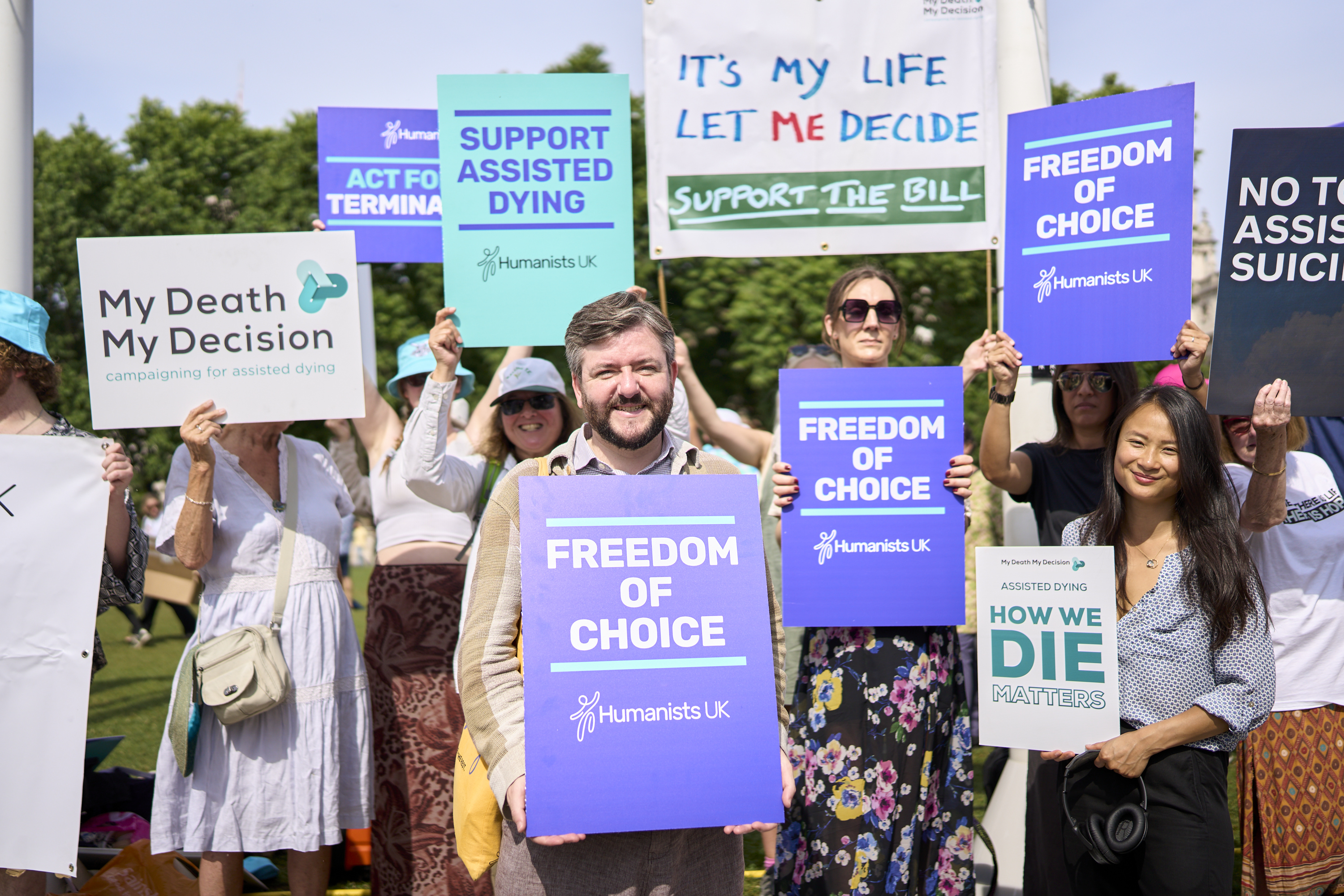
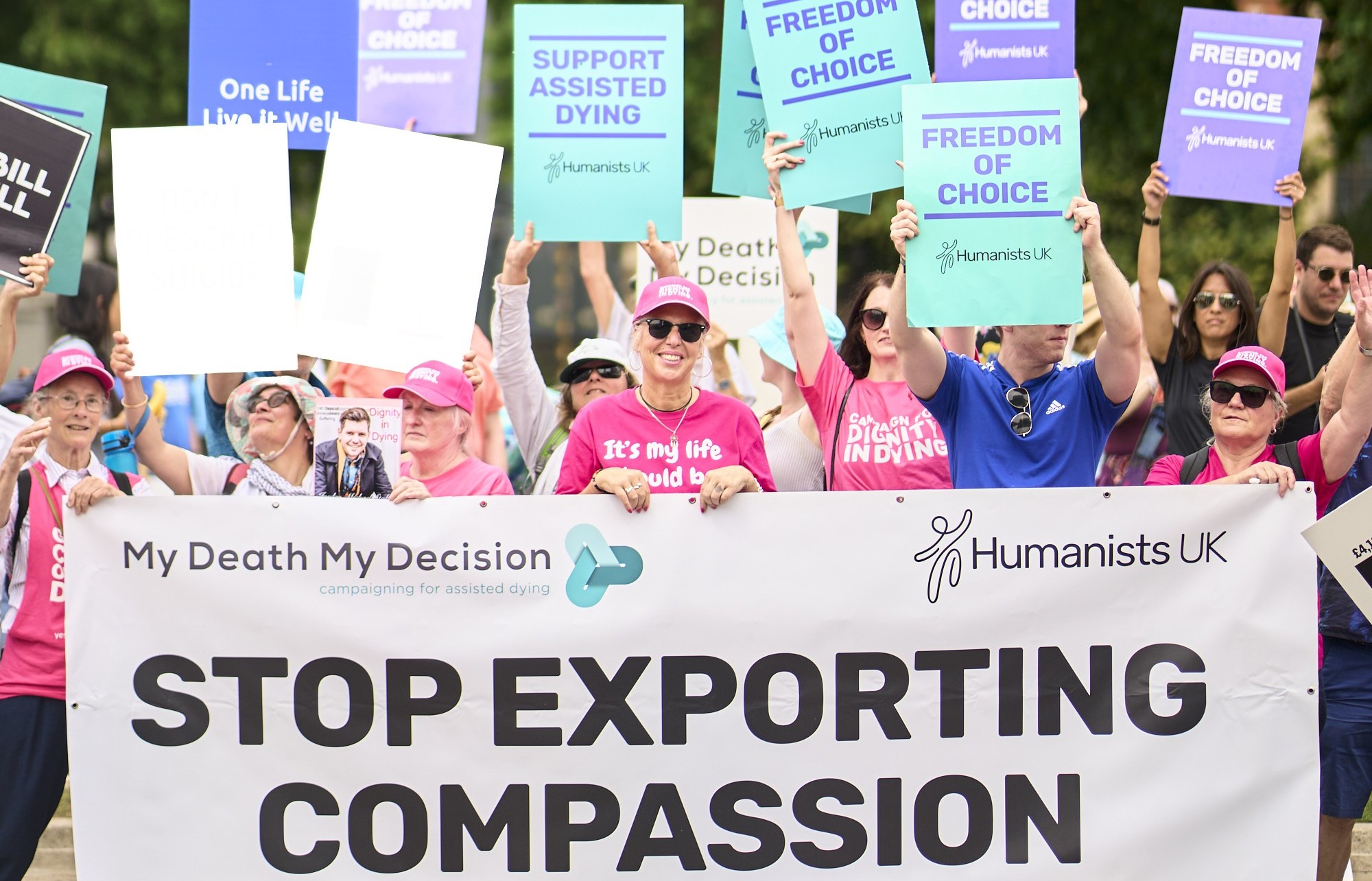
Humanists UK and My Death, My Decision have people and their loved ones who would be affected by this change available for the press.
If you have been affected by the current assisted dying legislation, and want to use your story to support a change in the law, please email campaigns@humanists.uk.
Humanists defend the right of each individual to live by their own personal values, and the freedom to make decisions about their own life so long as this does not result in harm to others. Humanists do not share the attitudes to death and dying held by some religious believers, in particular that the manner and time of death are for a deity to decide, and that interference in the course of nature is unacceptable. We firmly uphold the right to life but we recognise that this right carries with it the right of each individual to make their own judgement about whether their life should be prolonged in the face of pointless suffering.
We recognise that any assisted dying law must contain strong safeguards and the international evidence from countries where assisted dying is legal shows that safeguards can be effective. We also believe that the choice of assisted dying should not be considered an alternative to palliative care, but should be offered together as in many other countries.
Humanists UK is the national charity working on behalf of non-religious people. Powered by over 150,000 members and supporters, we advance free thinking and promote humanism to create a tolerant society where rational thinking and kindness prevail. We provide ceremonies, pastoral care, education, and support services benefitting over a million people every year and our campaigns advance humanist thinking on ethical issues, human rights, and equal treatment for all.
My Death, My Decision is a grassroots campaign group that wants the law in England and Wales to allow mentally competent adults who are terminally ill or intolerably suffering from an incurable condition the option of a legal, safe, and compassionate assisted death. With the support of over 3,000 members and supporters, we advocate for an evidence-based law that would balance individual choice alongside robust safeguards and finally give the people of England and Wales choice at the end of their lives.
Humanists UK and My Death, My Decision are both members of the Assisted Dying Coalition, along with Friends at the End, Humanist Society Scotland, and End of Life Choices Jersey.