

Humanists UK and My Death My Decision’s analysis of the Assisted Dying Bill’s House of Lords Committee Stage reveals:
- The transcript of the Committee Stage debate is longer than War and Peace
- Lord Harper has spoken more words than the contents of Orwell’s Animal Farm
- Baroness Finlay has spoken longer than the runtime of The Lord of the Rings: The Return of the King Extended Edition
- Opponents of the Bill have spoken for 55 hours, and spoken 462,749 words, twice as long as Moby-Dick and three-quarters of the total debate
- 43 UK citizens have died at Dignitas since the first reading of the Assisted Dying Bill in the House of Lords on 23 June 2025.
The House of Lords Committee stage of the debate has surpassed the word count of Leo Tolstoy’s epic novel War and Peace. Over 75 hours of debate, totalling 607,077 words, have led to only three minor changes to the Bill. Coupled with an outrageous, record-breaking number of amendments, and peers explicitly mentioning they intend to sabotage the Bill through procedure, Humanists UK and My Death, My Decision are clear that this is an undemocratic filibuster of the Assisted Dying Bill that was passed by MPs in the House of Commons last summer.
Humanists UK and My Death, My Decision will be outside Parliament on Wednesday 22 April, protesting the filibuster, and the final debate will take place on Friday 24 April. As there are no more debates scheduled, this will signal the end of the Assisted Dying Bill. The Bill will officially fail when the parliamentary session ends, and Parliament is prorogued.
The Parliament Act can be used to bypass the Lords and enact the Bill.
Committee Stage Analysis:
The Committee Stage in the House of Lords is when peers go through a Bill line by line to debate and test it in detail, though they usually do not make many changes at that point. Peers introduce their amendments, the government and then the Bill sponsor, Lord Falconer, responds, and then the amendment is withdrawn and can be put forward again at the following Report Stage.
Known opponents to the Bill have spoken a combined 462,749 words at Committee so far, more than twice as long as Moby-Dick (213,357 words).
By comparison, the House of Lords Committee Stage debate of the Renters’ Rights Bill, which is over 200 pages longer than the Assisted Dying Bill, has a word count of 249,057.
| Peer | Party | Words said |
| Lord Harper | Conservative Party | 37,233 |
| Baroness Grey-Thompson | Crossbencher | 36,591 |
| Baroness Finlay of Llandaff | Crossbencher | 35,595 |
| Baroness O’Loan | Crossbencher | 28,287 |
| Baroness Coffey | Conservative Party | 23,059 |
| Baroness Fox of Buckley | Non-affiliated | 21,741 |
| Baroness Berridge | Conservative Party | 16,076 |
A similar picture is painted by totalling up the speaking time using the index of the parliament.tv livestream. Opponents of the Bill have spoken for over 55 hours, nearly three-quarters of the 75-hour-long Committee Stage debate.
| Peer | Party | Speaking time (h:mm) | % of total debate |
| Baroness Finlay of Llandaff | Crossbench | 4:42 | 6.3% |
| Baroness Grey-Thompson | Crossbench | 3:45 | 5.0% |
| Lord Harper | Conservative | 3:32 | 4.7% |
| Baroness O’Loan | Crossbench | 2:56 | 3.9% |
| Baroness Coffey | Conservative | 2:34 | 3.4% |
| Baroness Fox of Buckley | Non-affiliated | 2:27 | 3.3% |
| Baroness Lawlor | Conservative | 1:55 | 2.5% |
Baroness Finlay has spoken for 4 hours and 41 minutes, longer than The Lord of the Rings: The Return of the King Extended Edition, which runs for 4 hours and 12 minutes.
The caveat to the speaking times is that the index does not pause when a peer interrupts another, known as an intervention. For example, in responding to Amendment 142, Lord Falconer was intervened on by Lord Harper, Baroness Berger, Baroness Fox of Buckley, Baroness Berridge, and Baroness Coffey. In reality, this means that opponents of the Bill have likely spoken for longer than indicated above.
As the sponsor of the Bill in the House of Lords, Lord Falconer must respond to each group of amendments, addressing each of the nearly 1,300 amendments in turn. To that end, he has spoken the longest, at 8 hours and 42 minutes and 63,852 words.
The filibuster:
43 UK citizens have died at the Swiss assisted dying centre Dignitas since the first reading of the Assisted Dying Bill in the House of Lords on 23 June 2025.
Since then, nearly 1,300 changes to the Bill have been proposed, with seven of the most vocal opponents putting forward nearly 700 amendments between them. Amendments have included a pregnancy test for all applicants, including men, a one-year holiday ban for applicants, and an unworkable requirement for half a dozen GP visits.
Peers spent nearly an hour debating a group of probing amendments from Lord Frost that would change the wording of ‘assistance to end their own life’ in the Bill to ‘medical help to commit suicide by provision of lethal drugs’. These amendments add nothing to the clarity, workability or safety of the Bill and replace neutral, clinically accurate language with stigmatising terminology.
We have identified several instances of peers being explicitly clear that they are trying to block the Bill by means other than it being voted down.
Nathan Stilwell, spokesperson for Humanists UK, said:
‘We could not be clearer. This is an egregious and undemocratic filibuster of the Assisted Dying Bill. No matter what metric is used, the evidence shows that opponents of the Bill, who will never support it and never be satisfied with any safeguard, have deliberately run down the clock.
‘Every single MP who wrote back to constituents, held surgeries and engaged with the assisted dying debate respectfully and seriously, has been overruled without a vote by an unelected chamber. Horrendously, the voices of the terminally ill have been shamefully overlooked and ignored entirely.
‘The elected chamber must bring back this Bill.’
Dave Sowry, Board Member of My Death, My Decision, said:
‘I’m equal parts outraged and distraught. Dying people were made to wait while peers talked and talked.
We welcomed scrutiny of this Bill and serious debate, even when that debate was difficult, and opinions differed. That is how Parliament should work.
‘When I listened to Baroness Finlay describing her failed attempts to resuscitate a little boy’s goldfish, it became obvious beyond all possible doubt that this was a filibuster. Instead of a good-faith effort to test and improve the Bill, we saw scaremongering and endless delay, while terminally ill people were ignored.’
Notes
For further comment or information, media should contact Nathan Stilwell at nathan@humanists.uk or phone 07456 200033. (media only)
Humanists UK is making the following photos available to the media to use – credit to Simona Sermont/Humanists UK – 1, 2, 3, 4, 5.
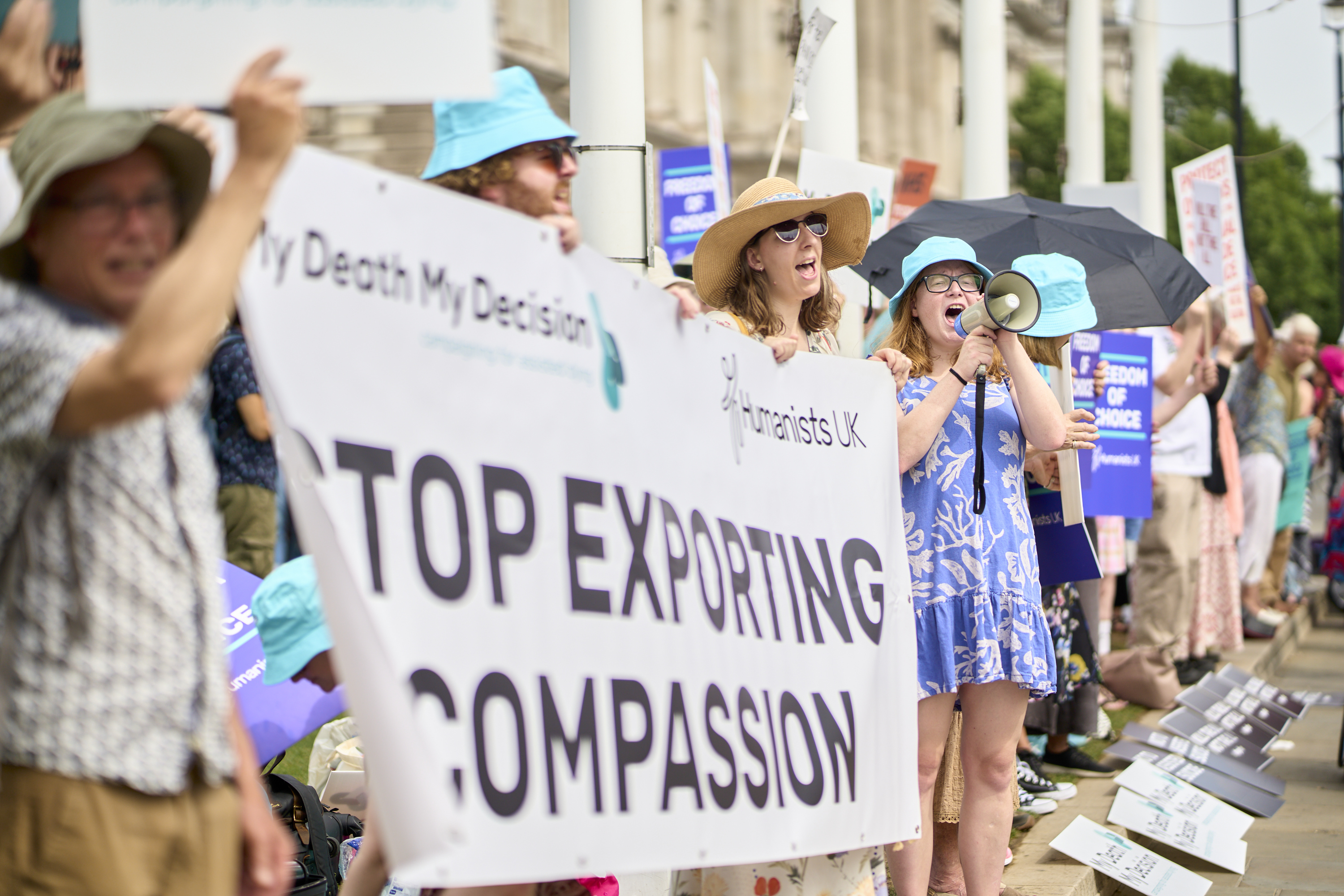
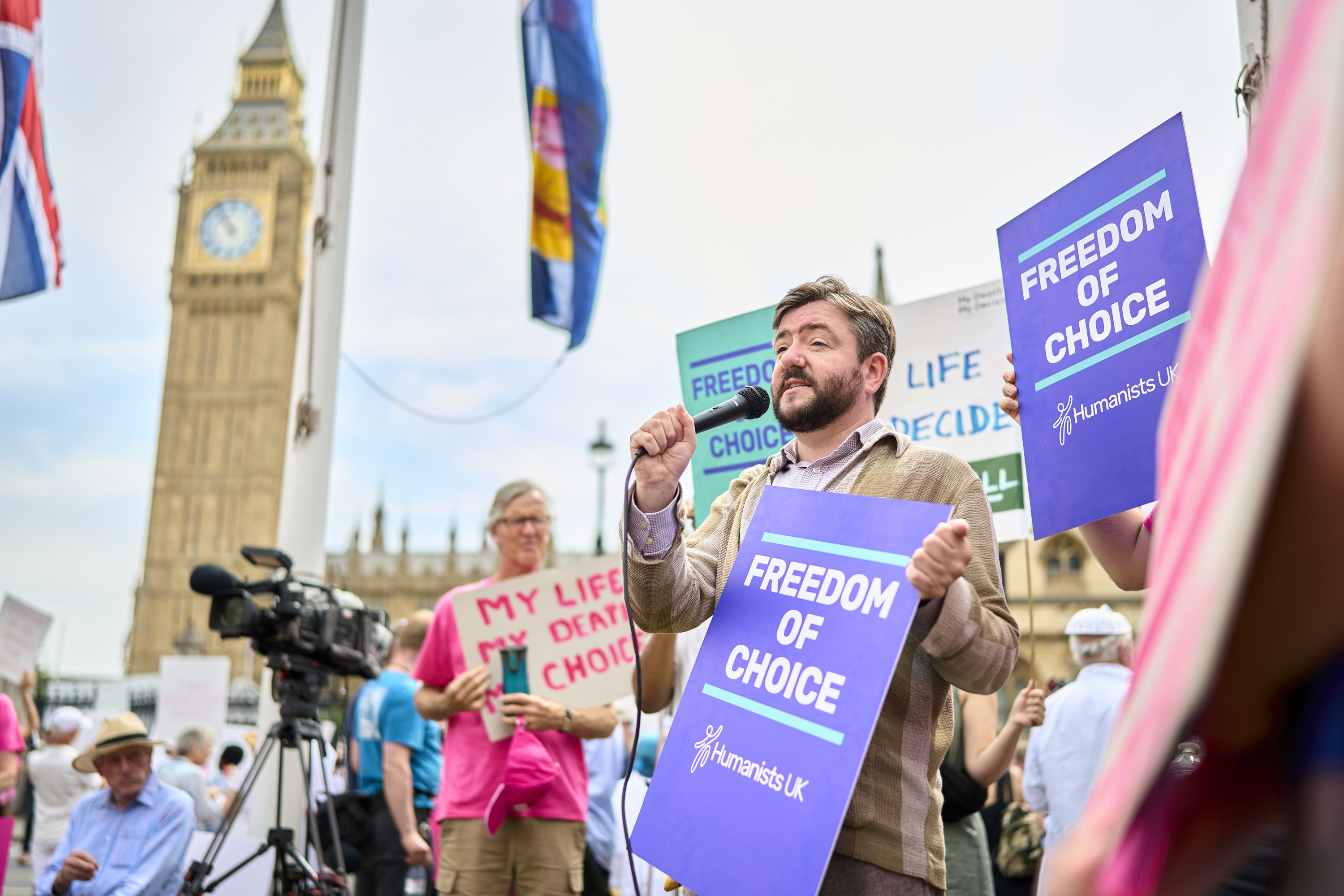
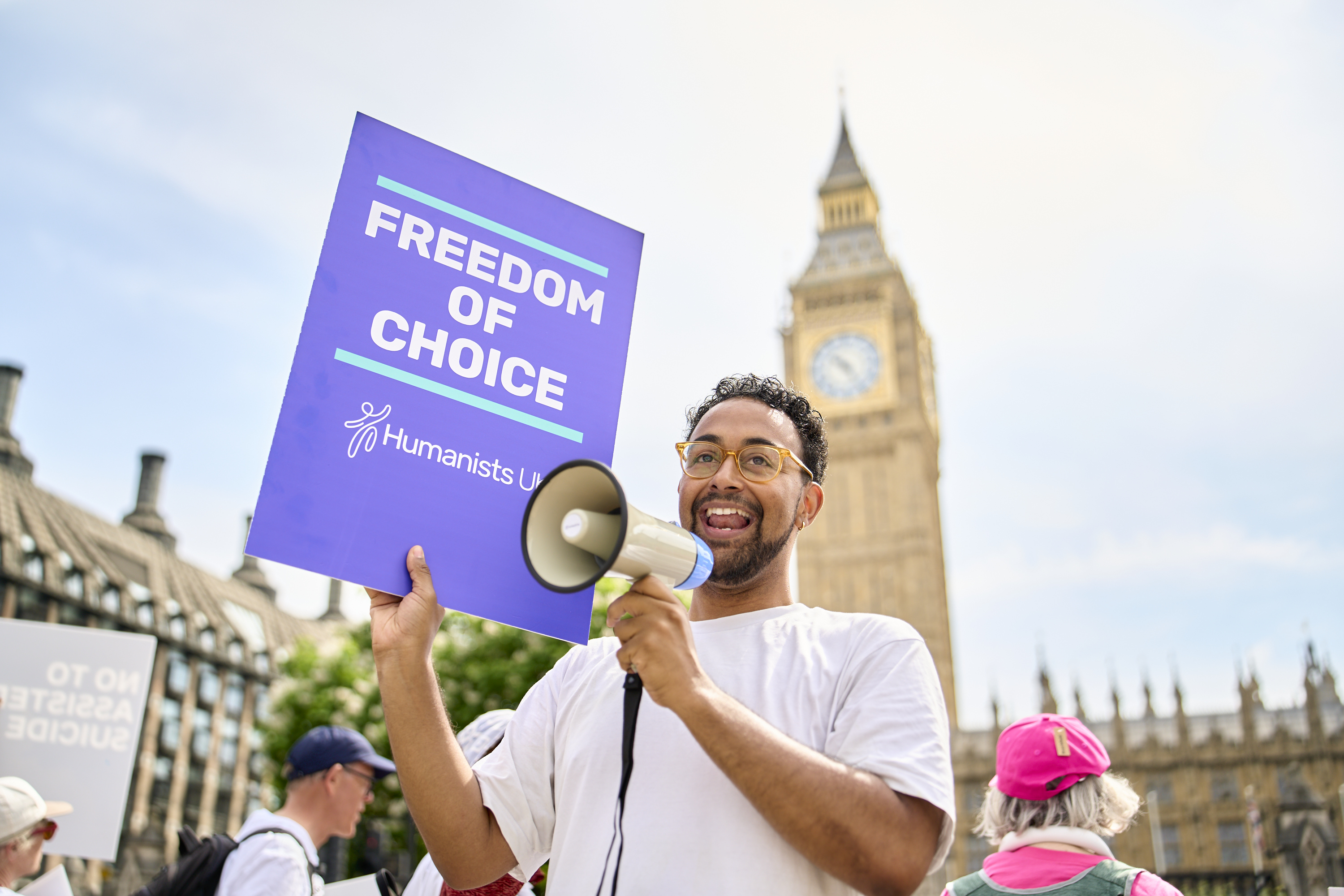
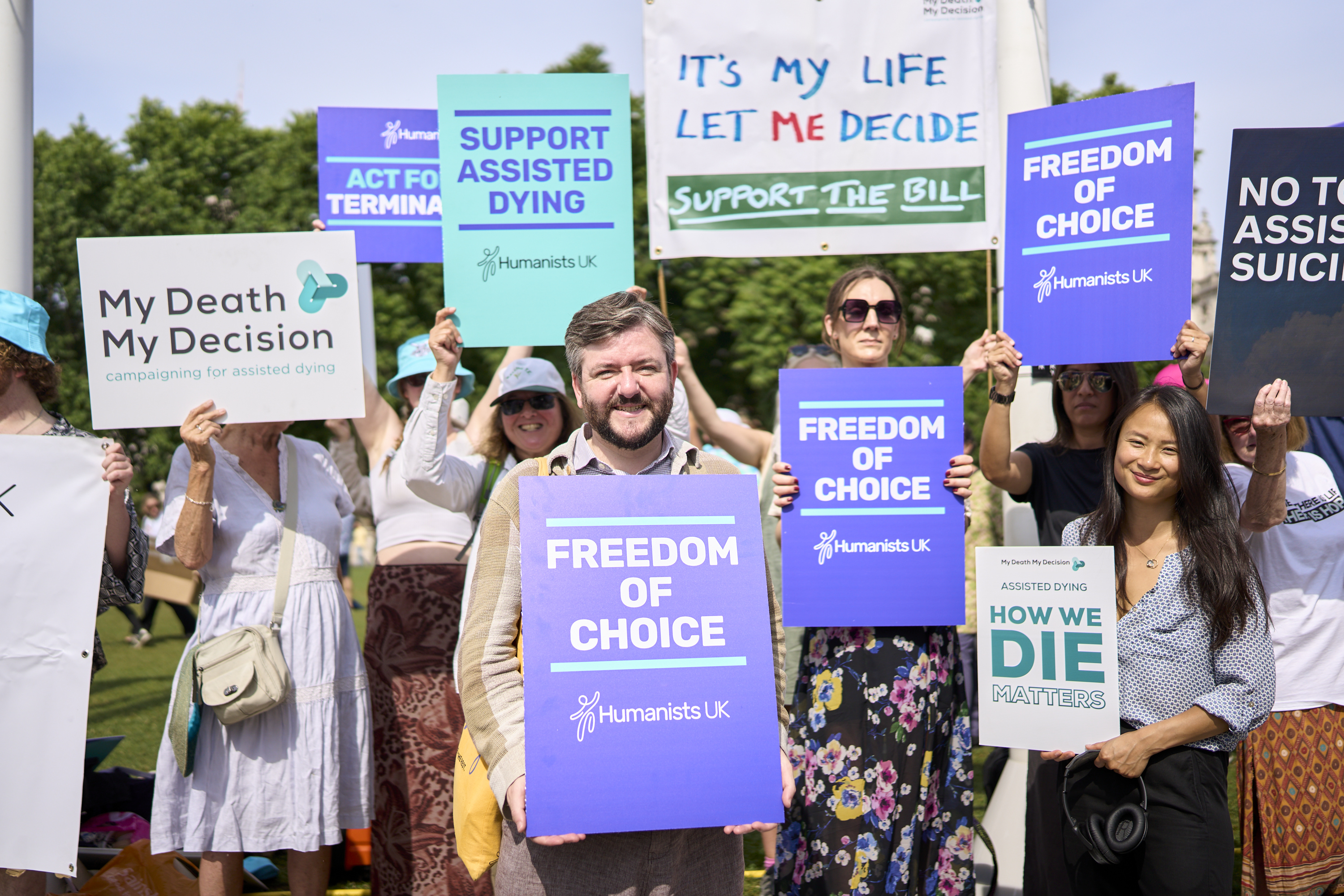
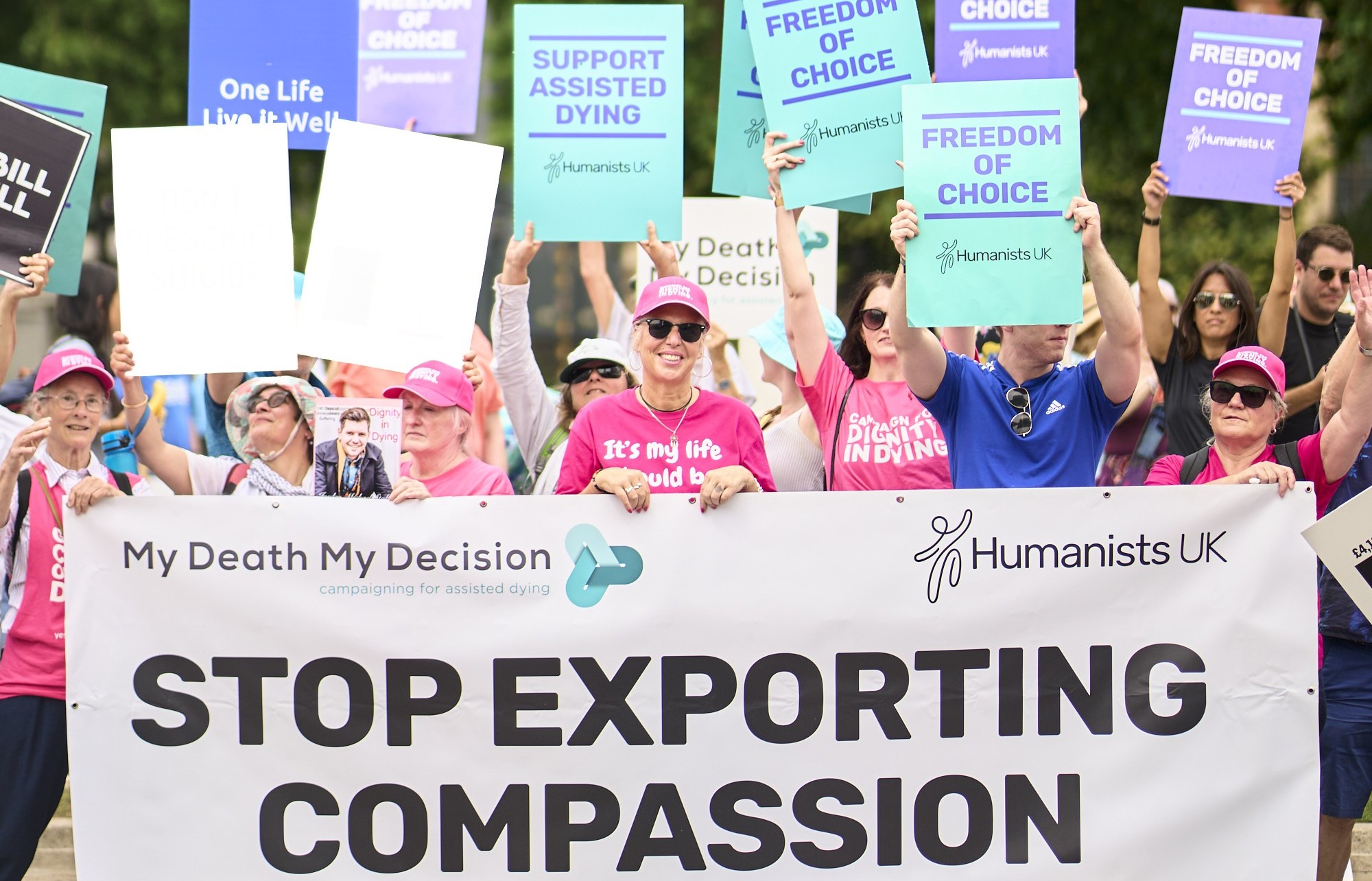
Humanists UK and My Death, My Decision have people and their loved ones who would be affected by this change available for the press.
If you have been affected by the current assisted dying legislation, and want to use your story to support a change in the law, please email campaigns@humanists.uk.
Humanists defend the right of each individual to live by their own personal values, and the freedom to make decisions about their own life so long as this does not result in harm to others. Humanists do not share the attitudes to death and dying held by some religious believers, in particular that the manner and time of death are for a deity to decide, and that interference in the course of nature is unacceptable. We firmly uphold the right to life but we recognise that this right carries with it the right of each individual to make their own judgement about whether their life should be prolonged in the face of pointless suffering.
We recognise that any assisted dying law must contain strong safeguards and the international evidence from countries where assisted dying is legal shows that safeguards can be effective. We also believe that the choice of assisted dying should not be considered an alternative to palliative care, but should be offered together as in many other countries.
Humanists UK is the national charity working on behalf of non-religious people. Powered by over 150,000 members and supporters, we advance free thinking and promote humanism to create a tolerant society where rational thinking and kindness prevail. We provide ceremonies, pastoral care, education, and support services benefitting over a million people every year and our campaigns advance humanist thinking on ethical issues, human rights, and equal treatment for all.
My Death, My Decision is a grassroots campaign group that wants the law in England and Wales to allow mentally competent adults who are terminally ill or intolerably suffering from an incurable condition the option of a legal, safe, and compassionate assisted death. With the support of over 3,000 members and supporters, we advocate for an evidence-based law that would balance individual choice alongside robust safeguards and finally give the people of England and Wales choice at the end of their lives.
Humanists UK and My Death, My Decision are both members of the Assisted Dying Coalition, along with Friends at the End, Humanist Society Scotland, and End of Life Choices Jersey.