
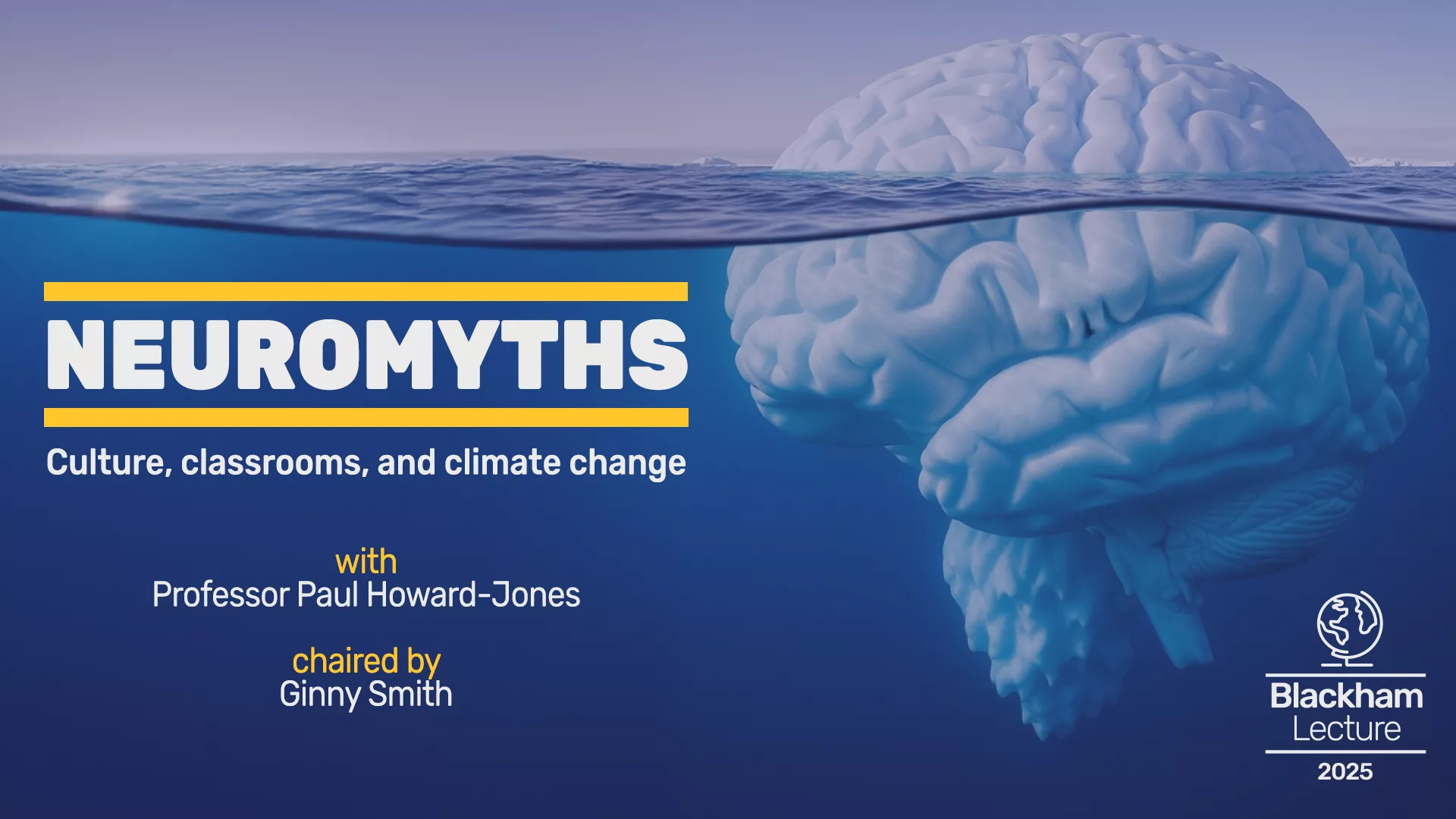
Humanists UK has today announced that Paul Howard-Jones, Professor of Neuroscience and Education, will deliver the Blackham Lecture 2025 on 19 November 2025. The online lecture, titled ‘Neuromyths: classrooms, culture, and climate change‘, will explore how popular but misleading ideas about the brain can hinder learning, misdirect educational policies, and even jeopardise efforts to tackle climate change.
Early bird tickets are available now.
The promise of neuroscience transforming education is alluring, but this excitement has a shadow: the proliferation of ‘neuromyths’. These compelling but scientifically unfounded beliefs about the brain have become pervasive in our culture. In his lecture, Professor Howard-Jones will dissect the origins of these myths, uncovering the powerful cultural forces and emotional biases that give them such a persistent hold on the public imagination.
These myths are not merely academic curiosities; they have serious, real-world consequences. Professor Howard-Jones will argue that popular misunderstandings about the brain are actively jeopardising our ability to provide effective sustainability education. At a time when empowering the next generation to tackle climate change has never been more urgent, this lecture will show how correcting our ‘folk neuroscience’ is essential for progress, offering a vital guide for anyone invested in the future of education and our planet.
Professor Paul Howard-Jones is a Professor of Neuroscience and Education at the University of Bristol. With a diverse background spanning engineering, psychology, and teaching, his research focuses on the intersection of cognitive neuroscience and educational policy. He was a member of the Royal Society’s working group on Neuroscience and Education and is known for his broadcasting work, including Channel 4’s The Secret Life of Four Year Olds. The lecture will be chaired by Dr Ginny Smith – neuroscientist, psychologist, and acclaimed science communicator.
Lori Marriot, Coordinator of Humanist Climate Action, commented:
‘To effectively confront the climate crisis, we need the next generation to be equipped with the best possible understanding of the science and the challenges we face. Professor Howard-Jones’ work is vital because it highlights how crucial evidence-based educational practices are in cutting through misinformation and fostering the critical thinking needed for meaningful environmental action.’
Humanists UK Chief Executive Andrew Copson said:
‘We are delighted that Professor Paul Howard-Jones will deliver the 2025 Blackham Lecture. His work exemplifies the humanist commitment to applying reason and scientific evidence to solve real-world problems. By untangling popular myths from scientific reality, his research not only stands to improve our education system but also to strengthen our ability to tackle one of the most urgent challenges of our time.’
Notes
For further comment or information, media should contact Humanists UK Director of Public Affairs and Policy Richy Thompson at press@humanists.uk or phone 0203 675 0959.
The Blackham Lecture 2025 will take place online on Wednesday 19 November, from 19:30–21:00.
About Professor Paul Howard-Jones
Paul Howard-Jones is Professor of Neuroscience and Education at the School of Education, University of Bristol, with degrees in engineering and psychology, and a PhD in medical physics. He was a teacher before becoming a trainer of primary and secondary school teachers and an inspector of schools. His research has focused on issues at the interface of cognitive neuroscience and educational theory, practice, and policy. He applies diverse research methods, from neurocomputational imaging studies to classroom observations, to understand learning processes.
About Dr Ginny Smith
A science writer and presenter with expertise in psychology and neuroscience, Ginny has a talent for making the complex comprehensible and a passion for brain science. She has co-written five highly illustrated books for DK publishing, including How the Brain Works and 1,000 Amazing Human Body Facts, and has had articles featured in publications from BBC Science Focus to the Telegraph. Her latest book for adults, Overloaded: How every aspect of your life is influenced by your brain chemicals, published by Bloomsbury, was chosen as one of the ‘Books to read in 2021’ by New Scientist.
Ginny founded Braintastic! Science, which produces spectacular science shows and resources to help young people understand and get the best out of their brains. She is regularly found on stage at schools, festivals, and events, and relishes answering kids’ questions about the brain, from why we dream, to whether doctors could ever do a brain transplant.
She also teaches at the University of Cambridge’s Institute of Continuing Education, and is a regular blogger and video presenter for the Cosmic Shambles Network.
About the Blackham Lecture
The Blackham Lecture explores an aspect of education, lifelong development, or childhood that relates to humanism, and can be philosophical, practical, or social in its focus. The lecture and its accompanying medal are named for Harold Blackham, an educationist and pioneering activist who was the first executive director of Humanists UK and the first general secretary of Humanists International. The Blackham medallist is awarded to an individual who has made a significant contribution to the field of education or humanist philosophical inquiry.
About Humanists UK
Humanists UK is the national charity working on behalf of non-religious people. Powered by over 150,000 members and supporters, we advance free thinking and promote humanism to create a tolerant society where rational thinking and kindness prevail. We provide ceremonies, pastoral care, education, and support services benefitting over a million people every year and our campaigns advance humanist thinking on ethical issues, human rights, and equal treatment for all.